Monday, May 28, 2012

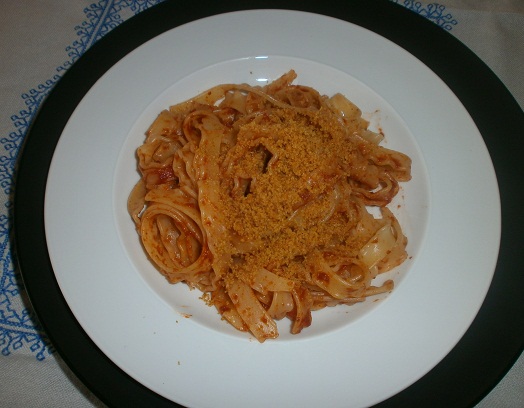
'Pasta con l'anciova', breadcrumb is the secret!

0 comments

Do you know how to make one of our most renowned plate of pasta? It's what we call "pasta cu l'anciova" which means pasta with anchovy, plus tomato puree as the main ingredients. When you will prepare it you will smell the parfum of Sicily!!!

Ingredients & preparation for 4 people:
400 gr - pasta (better if Margherite) - 150 gr tomato puree or extract - 1 clove of garlic - 5-6 anchovies - 6 spoons of breadcrumb - extra virgin olive oil - *Perfect for vegeterians as well!

First of all, you probably know already that we have tons of different shapes of pasta. For this specific one we don't use normal spaghetti, but the so-called "Margherite" which are long, thick, half straight and half curly. They are cute and funny!

So, let's start with putting on the pot for the pasta as usual. For preparing the sauce, take a sauce pan, put it on a medium heat with a drizzle of oil of olive and a clove of garlic. After a minute put the anchovies and with a a wooden scoop or a spatula cut them into tiny pieces until they are completely melted. Now it's time to add the tomato puree, which is usually quite dense and thick. Use the same wooden tool.
In the meantime if the water is boiling, salt it and drop the pasta in (if you don't find the margherite just use spaghetti or penne). With a dipper pour some water pasta in the sauce to help the puree melt easier and quicker. You will see that it will look like a proper sauce in few moments.

The amount of water that you had depends on the rest of the ingredients, especially the tomato extract so be careful in balancing because we don't want the sauce neither too dense (remember that we have to add the breadcrumb) nor too watery.
Once the sauce is done put a frying pan on a high heat with 5 or 6 spoons of breadcrumbs, add some olive oil and start mixing the two with a spoon, stirring continuously as we don't want to burn the breadcrumb on a side.

This is very important because it will substitute the usual grated cheese that we normally put on pasta dishes. Little bit of story: The origin is obviously a poor one, infact people in ancient times couldn't afford to buy cheese to put on pasta, so they created this solution that was definetely cheaper!!!
Ok, everything is ready now, drain the pasta and mix it well with the sauce.
If you are uncertain about the quantity of sauce I would say: better to be abundant in this specific case, because as I said before we don't want to eat something that is too dry. Now do the dishes adding a little bit of what we call "muddica atturrata", which is the toasted breadcrumb.

Tip: To avoid the sauce from being too dense and dry, better to leave aside (for example in a mug or cup) some water where the pasta has cooked that you can add on your need. To serve it properly place the breadcrumb into a boat that you normally use for gravy and enjoy!!!

Sunday, April 29, 2012

Sicilian mandarine and orange jelly: light and refreshing!

0 comments
Do you know how to make a lovely parfumed Sicilian mandarine and orange jelly? This is the easiest thing in the world, it's delicious and perfect to refresh your mouth especially after having eaten a big meal and it's the best way to give vitamin C to your kids when they are too lazy to peel an entire orange!

Ingredients and preparation for 4 people:
1/2 liter of fresh mandarine and orange juice (about 6 mandarines and 8 oranges, but really depends on how big and juicy they are)
2 spoons of sugar
25 gr. fish glue


First of all, you need to obtain 1/2 liter of fresh mandarines and oranges juice, so you have to squeeze them carefully removing the pulp afterwards. If the juice is already mixed to a large quantity of pulp you can use a small colander to strain the juice.
Once you have your half liter, leave it aside for few minutes and in a medium sauce pan put a glass of water at room temperature and the thin sheets of fish glue. This is an eatable substance that looks like a small 
transparent sheet of paper. When you buy it, is hard, then you leave it 10 minutes in the water and becomes like jelly.
Once it is so, on a medium heat put your sauce pan with the fish glue that has melted in the water and stir slowly, it will melt completely!

Now it's the time to add our lovely squeezed juice and keep stirring. When the juice is still liquid but hot (it doens't have to reach the boiling phase) we can remove it from the heat and pour it in our bowl and let it cool off, stirring from time to time.

As soon as it's cold let's put it into the fridge and leave it there for at least 3 hours. After one hour or so, go and check if the "thing" is actually becoming a real jelly. Normally it sure does and you can enjoy the freshness and lightness of our Mediterrenean fruits. Enjoy!

Ps - Don't forget that if your oranges are particularly sweet or you just try to avoid sugar as much as possible, you can eliminate it, I prepared it many times without it and the result is still excellent!

Saturday, March 24, 2012

A delicious spring pasta: Bronte's pistaches pesto & speck

0 comments

Do you know what the pesto of pistaches is? It is a sauce made of mashed pistaches from Bronte, a town near Catania, and it is mixed with some salt, pepper and oil of olive. It is a product that people normally buy in supermarkets but I don't think you find it anywhere else out of Sicily.

The recipe that I am going to put is something my mum and I created on a sunday morning, while we were thinking about an original nice way to dress our pasta. We like to try combining different ingredients so we decided to use not only a Sicilian pistaches pesto but also some speck, which is a smoked Parma ham typical of the region of Trentino Alto Adige, up in the north, added some creamy cheese as well and it was just fabulous! We couldn't have a better result! 
So with a little more imagination we can say that Italy is united in this dish also in our three colors of the flag :) 

Ingredients & preparation for four people:
380 gr. penne rigate (or any other type of pasta you like)
4-5 tablespoons of pesto
80 gr. speck thinly sliced and chopped in pieces
2-3 tablespoons of creamy cheese (like Philadelphia or similar)
3-4 leaves fresh mint
some grated lemon zest
black pepper

Cook the penne as usual, adding salt when the water boils. While they are cooking, in another sauce pan or frying pan, put the chopped speck on a medium heat, after a couple of minutes add the pesto of pistaches and some hot water taken from the pasta, add the creamy cheese as well, a bit of black pepper, the leaves of mint and some grated lemon if you like them all and... voilà the sauce is ready!
As soon as the penne are cooked, drain and sautè them in the sauce pan with the dressing, mixing well all together. Sprinkle with Parmisan cheese on top and the whole of Italy is served right on your table! Delicious!!!

Saturday, March 10, 2012

Local Expert Award ? The Sicilian Cuisine Blog is in!!!

0 comments


This short post is to thank the website Charming Sicily to have awarded me with the title of 'Sicilian Local Expert'. It's always nice when somebody you don't know drops you a few lines to say how much appreciates your blog, but it's even nicer when somebody actually thinks you are worth getting an award, even if a virtual one!


To be honest with you, I have never felt like an expert, so I am particularly honoured, therefore I will treat it as very valuable indeed! Thank you so much from the bottom of my heart :-)))

Friday, March 2, 2012

Exquisite fava beans mash: the Sicilian "maccu"

0 comments
Do you know what is the so-called "MACCO DI FAVE"? In Sicilian the word macco becomes maccu and is used to name an exquisite dish we prepare with dried and peeled fava beans. It is a mix between a thick soup and a puree, because when you cook fava beans they mash up and become an homogeneous soup. You can also have it with pasta, as one of our 'minestra'.


Here comes the recipe for 4 people:

250 gr dried peeled fava beans
3 ts tomato sauce
a small bunch of wild fennel (like 20% of the one in the pic)
3 ts extra virgin oil of olive
hot chili pepper (a little piece or half of it)
salt


Preparation:

First of all, wash the fennel under running water. In a pot on a medium heat put some water (about 1 litre) with the fava beans. As soon as the water starts to boil add salt, fennel cut in small pieces and half of a little chili pepper and reduce the heat at the minimum.
Let the beans cook slowly, stirring from time to time so that they don't get stuck at the bottom. To obtain the mash they have to cook about one hour all together, but it also depends on how water you put. If it's too much wait until the majority of it is absorbed by the fava beans. 
After the first 25 or 30 minutes, add the spoons of tomato sauce and olive oil. Finally, serve hot with grilled slices of rustic bread spread with a clove of garlic.

It's simple, it's healthy and delicious, everyone loves it and is also perfect for vegeterians. Can we ask for more? :-))

Tuesday, February 21, 2012

The period of Carnival: costumes and sweets galore!

0 comments

Do you know what the Italian Carnival is? The Carnival in Italy is the period of festivity dedicated to the children and it always comes before the Lent, the forty days of Penitence that lead to Easter. In Sicily the most famous Carnival festivities are in Acireale (near Catania, the pic above), in Sciacca (near Agrigento), and in Termini Imerese (near Palermo). Normally people, above all kids, wear particular costumes, so it's quite common in these days to see walking little Supermen, cowboys, Robin Hoods or princesses along the street with their parents. So cute! 
At the table the Carnival is the period in which you really can get fat and enjoy food, infact traditional sweets are usually fried and we call it with a general word: "frittelle".  Frittelle means something sweet and fried.


To be more specific though, we have lots of stuff that we prepare: the most renowned in the whole of Italy are definetely the 'CHIACCHIERE', that means 'chats'. This crunchy sweets are called so because you eat one after the other while chatting.

By the way, I have to warn you that even if they are made all over the country in every region of Italy have a different name (cenci, galani) and shapes (rectangular, little knots), which is interesting but sometimes a bit confusing. In Sicily we call it chiacchiere and especially if homemade, they are delicious, because we add some parfumed liquoer, Marsala is usually the best and make them really special!

Here comes the recipe:
200 gr flour - 2 eggs - 20 gr caster sugar - 20 gr soft butter - 2 spoons of Marsala - a pinch of salt - oil of olive for frying.
In a bowl mix the flour with all the other ingredients: salt and sugar, butter and Marsala, then the 2 eggs previously beaten. Make the dough little by little, until it becomes elastic and homogeneous. Give it the shape of a ball, wrap it up with a kitchen cloth and leave it aside for about 30 minutes. Then, using the rolling pin, roll it out, but not too thick, about 1/2 cm. Now, you can cut it and make all the shapes that you want.
In a frying pan put some olive oil, when is hot enough fry the chiacchiere until they become gold-ish. Finally sprinkle icing sugar on top and serve still warm. You will chat a lot! Ahah... just exquisite!

Monday, February 20, 2012

The stuffed rustic bread in Sicily is called "pane cunzato"

0 comments


Do you know what "pane cunzato" is? And how can we make it? Pane cunzato in Sicilian dialect means literally stuffed bread. When we talk about this preparation which is easy and delicious, we have to find out which are the secrets to make a great pane cunzato.

The first is obviously the bread: we use the long-shaped rustic one that in Sicily is called "filone". It is perfect because is soft inside but crispy outside. The second secret is obviously the oil. It must be rigourously extra virgin olive oil, seasoned with some salt and black pepper. If you have fresh rustic bread and a really good olive oil your pane cunzatu will be absolutely amazing. But it's not just that!

We also add, traditionally, three more ingredients: anchovies that give a strong taste, some slices of tomato that give softness and freshness in the mouth and an abundant sprinkle of oregano, which makes the different! So, if you are hungry and fancy some genuine Mediterranean taste, don't have to wonder what to prepare anymore. You know the answer!  :-) 
Enjoy! 
 
ban nha mat pho ha noi bán nhà mặt phố hà nội