Showing posts with label veggie. Show all posts

Sunday, February 3, 2013

"Panelle & Kitchen qb": Sicilian street food introduced by our first guest of the year

0 comments
P like PALERMO, P like PANELLE. 
The two words are forever bond, because the 'pane e panelle' (the panelle sandwich) is together with the other famous 'pane ca' meusa' (the spleen sandwich), the most distinctive and representative street food of the Capital of Sicily. Infact if you ask an Italian about it, I am pretty sure he doesn't know what I am talking about unless he/she has been in Palermo on holiday. If you ask a Sicilian (from another part) he would probably shrug his shoulder too

What eaxctly are they, then? They are fritters made of chickpea flour and water. 
How are they? Flat. Superb. Unique. Delicate. These are only few adjectives to describe the PANELLE and trust me, the average Palermo-dweller is totally in love with them regardless of age, profession or social status.

So... there's no better traditional recipe than this, to guest another food blogger to talk about it. Her name is Silvia and her blog (in Italian language) is called Kitchen qb. It's a lovely, well written and inspiring blog and she is not only a great cook but also an excellent photographer. Now she is in her own words... talking about this dish:

<<Here we go! Let's start talking about street food. My city Palermo is famous for this kind of food, so I can't help talking about one of the most renowned one: the panelle. Introduced by the Arabic domination, this food made of chickpeas flour, water, salt and parsley has its  culmination in the final frying phase because of the superb and tasteful result. 

The panelle are usually placed between a rounded bread bap with sesame seeds on top and it's a treat to stuff the panino with potatoes croquettes as well (in Palermo dialect also called "cazzilli", colorful diminuitive referring to their shape that reminds a part of a male body). 
Where we can find them? Anywhere... in every corner of the city, especially in the "friggitorie" (spots that sell fried food) or at the local peddlers that, with their smell, perfume the entire city.
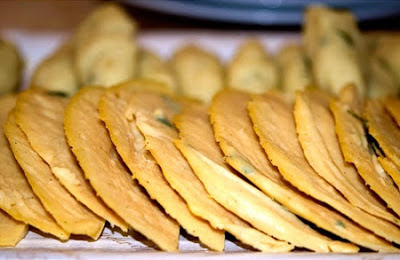
Ingredients & Preparation:
  • 500 gr chickpea flour
  • 1,5 litre water
  • thinly chopped parsley (as required)
  • e.v. olive oil
  • salt
  • sesame seeds (optional)

1. Fill a large pot with 1 lt water, add the chickpea flour little by little and stir constantly with a whisk to avoid lumps. Put the pot on a medium heat, add a good pinch of salt (about 20 gr.) and keep stirring until it starts boiling and getting thicker.
2. When this mixture will be more solid (similar to the polenta) you can add the parsley and remove from heat.

3. Place the dough on a marble surface previously oiled (or on an oiled oven tray) and flatten it with a spoon or a spatula. Once it has cooled down, with a knife, make some rectangles.
4. Pour some olive oil in a pan on a high heat to start frying our panelle on both sides until golden. 5. Place them on some kitchen paper to absorb the exceeding oil and add a pinch of salt. 6. Serve immediately while still hot, together with little rounded panini.


Note: I only use olive oil for frying, so I suggest to use this one for a better result. Some people also like to squeeze few drops of lemon juice on top and a pinch of black pepper, if you have never tried them, this is about the time.>> 

Silvia

--- Here you can find Silvia's post in Italian language.

Thank you so much to Silvia for being such a lovely guest on my blog. I have to say I do love having panelle with lemon juice on, because its bitterness perfectly combines with the fritters. You can prepare them as starters for a big meal, as finger food on a buffet, or as a proper meal inside a big panino (bread) for a quick lunch on the go, just like Silvia suggested in her recipe and pictures. 

No matter which is the occasion and when you gonna have them, they will blow you away! That's for sure. And vegeterians will love them too! Isn't it amazing?

To make this gorgeous and delicious recipe perfect, let me add a pinch of history: the Arabs that dominated our island from the 9th to the 11th century, were innovators and started to grind the seeds of the chickpeas. The result was flour that, mixed to water and cooked in a pan on a heat, gave a kind of raw dough, that wasn't particularly tasty. But after experimenting they found out that the same dough, cut in thin slices and fried in oil, made a delicious food with an inviting golden color, and little by little, it became very popular. That's how panelle were born.
 

And the love story between them and the city of Palermo lasts ever since.


The pictures are all property of Silvia Crucitti & Kitchenqb, except the pic at the top, taken by Rachel Bajada for the SicilianCuisineBlog; you are not allowed to take or download any of them without asking for permission. Thank you.

Monday, May 28, 2012

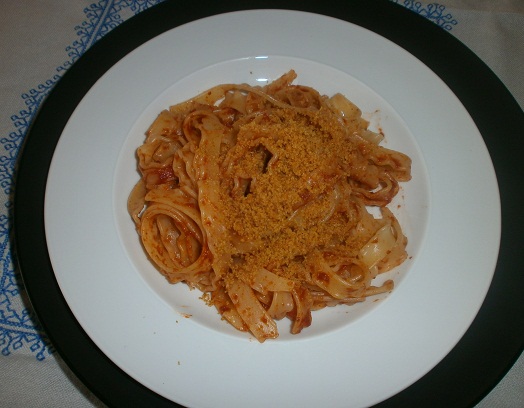
'Pasta con l'anciova', breadcrumb is the secret!

0 comments

Do you know how to make one of our most renowned plate of pasta? It's what we call "pasta cu l'anciova" which means pasta with anchovy, plus tomato puree as the main ingredients. When you will prepare it you will smell the parfum of Sicily!!!

Ingredients & preparation for 4 people:
400 gr - pasta (better if Margherite) - 150 gr tomato puree or extract - 1 clove of garlic - 5-6 anchovies - 6 spoons of breadcrumb - extra virgin olive oil - *Perfect for vegeterians as well!

First of all, you probably know already that we have tons of different shapes of pasta. For this specific one we don't use normal spaghetti, but the so-called "Margherite" which are long, thick, half straight and half curly. They are cute and funny!

So, let's start with putting on the pot for the pasta as usual. For preparing the sauce, take a sauce pan, put it on a medium heat with a drizzle of oil of olive and a clove of garlic. After a minute put the anchovies and with a a wooden scoop or a spatula cut them into tiny pieces until they are completely melted. Now it's time to add the tomato puree, which is usually quite dense and thick. Use the same wooden tool.
In the meantime if the water is boiling, salt it and drop the pasta in (if you don't find the margherite just use spaghetti or penne). With a dipper pour some water pasta in the sauce to help the puree melt easier and quicker. You will see that it will look like a proper sauce in few moments.

The amount of water that you had depends on the rest of the ingredients, especially the tomato extract so be careful in balancing because we don't want the sauce neither too dense (remember that we have to add the breadcrumb) nor too watery.
Once the sauce is done put a frying pan on a high heat with 5 or 6 spoons of breadcrumbs, add some olive oil and start mixing the two with a spoon, stirring continuously as we don't want to burn the breadcrumb on a side.

This is very important because it will substitute the usual grated cheese that we normally put on pasta dishes. Little bit of story: The origin is obviously a poor one, infact people in ancient times couldn't afford to buy cheese to put on pasta, so they created this solution that was definetely cheaper!!!
Ok, everything is ready now, drain the pasta and mix it well with the sauce.
If you are uncertain about the quantity of sauce I would say: better to be abundant in this specific case, because as I said before we don't want to eat something that is too dry. Now do the dishes adding a little bit of what we call "muddica atturrata", which is the toasted breadcrumb.

Tip: To avoid the sauce from being too dense and dry, better to leave aside (for example in a mug or cup) some water where the pasta has cooked that you can add on your need. To serve it properly place the breadcrumb into a boat that you normally use for gravy and enjoy!!!

Thursday, October 20, 2011

Filled bell peppers: gorgeous Mediterranean taste

0 comments

Do you know how to make some bell peppers filled with cheese and olives? This is a typical Sicilian side-dish and it has definetely got a great Mediterranean taste. There are several fillings for these vegetables, but I like to do a simple one, not long, nor difficult.


Ingredients & preparation for 4 people:
2 bell peppers
80 gr. green pitted olives
150 gr. Sicilian primo sale cheese
4-5 ts breadcrumb
3 ts tomato sauce
e.v. olive oil
oregano
salt


1. Cut the bell peppers in half, remove the inside and the seeds and wash them under running water.
2. Switch the oven on at a temperature of about 180° C.

3. In a bowl or a large dish put the breadcrumb and mix it with the olive oil, the tomato sauce, a pinch of salt and the olives cut in halves or even better in slices. Sprinkle with abundant oregano.
4. Now cut the cheese in cubes.

5. In an oven dish, put a drizzle of oil at the bottom and with a spoon start filling the pepperoni one at a time, first with the breadcrumb mix and then topping with the cubes of primo sale cheese (or any other tasty cheese you like).
6) Place them in the oven dish and let them cook for about 30 minutes or so. Better if you check after 20 minutes and see how the cooking is going, the cheese must melt and the bell peppers have to be quite soft.

Serve them when they are getting warm, it will be the perfect moment because you can appreciate the different flavours of the dish without burning your mouth. This is a typical Mediterranean recipe, also perfectly suitable for vegeterians and I really hope you can enjoy it!

Friday, September 30, 2011

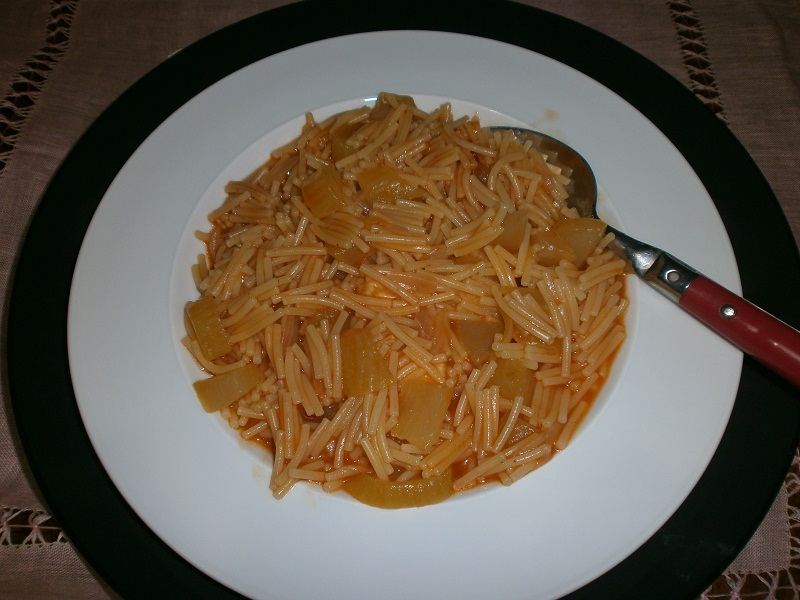
Pasta with squash, our summer & fall "minestra"

0 comments

Do you know how to cook "pasta con la zucchina a minestra"? I already told you about pasta a minestra in general, now we are preparing a specific minestra with squash. This is a great summer and autumn dish.

I know I know, everyone thinks that in summer you only have to eat cold or refreshing food, but Sicilian tradition do not agree with that. Infact in Summer we also prepare some types of pasta made with broth, like a soup, and this is exactly one of them. You may not have it too liquid (like it is in the pic above, but that depends only on your personal taste!) Even better is having it in this season, when the first rains arrive.

Ingredients & preparation for 4 people:
1 half of a squash (if very long)
1 small onion
400 gr. broken spaghetti (Ital. spaghetti spezzati)

4-5 ts of tomato sauce
80 gr. matured caciocavallo cheese in small pieces
salt (or a bio stock-cube if preferred)
olive oil
a small piece of dried red pepper

1. You peel the squash (pic on the left), cut it in half and then in thin slices. 2. On a medium heat put a large pan with half the water. 3. As soon as the water boils put salt (or a bio stock-cube if preferred), onion and the squash in pieces. 4. After about 12-14 minutes put the pasta and the tomato sauce. For this dish we use the "spaghetti spezzati" type of pasta, which are simply broken spaghetti.
5. When the pasta is almost cooked (usually after 10-12 minutes) put the little pieces of caciocavallo cheese inside the soup, so that they have the time to melt a bit (matured caciocavallo is very hard).This local cheese is very salty and tasty, so is the perfect contrast with the delicate taste of the squash.

If you want to try this lovely pasta don't hesitate: it's simple, healthy and tasty. Perfect for vegeterians or even health food nut people :) Enjoy!

Thursday, September 22, 2011

Fresh homemade tomato sauce: it's worth doing it!

0 comments
Do you know how to make a fresh delicious homemade tomato sauce? Have you ever tried?

The making of tomato sauce (in Italian salsa di pomodoro) definetely reminds me of my childhood summers spent in our country-house along with my family and my maternal grandparents.

My mum and my grandma sometimes were doing the "salsa" (literally means sauce and when we say the word alone it only means tomato sauce). I used to watch the process, not the entire one though, as it was very long and after a while I inevitably got bored; so I was coming and going from the kitchen from time to time.


Last week after so many years I decided to prepare once again some fresh tomato sauce. Contrary to what I used to think when I was 10, it didn't seem to me neither long nor boring. That's good! 
It took me just an afternoon (cooking time included) and the result was great! I was so proud :-)

Ingredients:
1 kg ripen tomatoes

1 onion
1 full teaspoon of salt
1/2 spoon of caster sugar

black pepper
olive oil
fresh basil
cinnamon in powder
nutmeg

1. Wash the tomatoes under running water, then roughly cut them and put them in a sauce pan together with the sliced onion. Let cook the two together for about 30 minutes on a very low heat with a lit.
2. After that
 it's time to mash them up. To help you speed up the process you can first blend the mix; this will facilitate the squeezeing phase. 
3. To squeeze them put them in a strainer. I have an electric tomato strainer (or squeezer... I am not sure how you exactly call it) so it's very easy (See the pic here on the left). When you have finished the squeezing phase, the liquid that you have gathered in the sauce pan is very watery and needs to be reduced to the proper thickness of the tomato sauce, so it has to cook again on a very low heat for at least two hours and half or until it is not watery anymore.


4. As soon as the liquid is becoming more and more "sauce" than water add all the ingredients to make it tasty: salt, sugar, a pinch of black pepper, nutmeg, cinnamon and some fresh leaves of basil. Taste it and adjust with salt and sugar if needed.

In the end add also a drizzle of extravergin olive oil... and that's pretty much it, your fresh homemade tomato sauce is ready!!!
You can use it on your pasta, bruschettas, pizza or wherever you like. You will be proud too! ;-)


Enjoy!

Saturday, July 16, 2011

Let's talk about "CAPONATA!"

0 comments

Do you know what "caponata" is? With this word we generally refer to the caponata made of eggplants (or aubergines) but it's actually a generic word to indicate a specific Sicilian sweet & sour sauce with which we like to cook and season several kind of vegetables, but not only.
In ancient times people used to have it with fish and white meat as well, while today we make the traditonal one with eggplants and different other versions like artichokes, carrots and even green apples. Delicious!!!


What probably happened in the past was that rich and noble people used to have it with fish and meat, but the majority of the population coudn't afford it, so they just substituted the expensive food with a cheaper one, and the fried eggplant/aubergine was the perfect ingredient for its  soft consistency and its not particularly strong taste.


History: To talk a little bit more about the introduction of the caponata sauce in Sicily we have to go back to the Middle Age, during the Saracen domination. Infact they were the ones to introduce it in our island.
Its secret is the perfect balance between the sweet (sugar or honey) and the sour (vinegar).
Then capers, olives, onion, celery and tomato sauce were added in the following centuries on a drizzle of olive oil.


It was a dish that became very popular among Sicilian sailors on ships, because it was easier for them to eat the rusk on board with a more scented sauce.


For us it's a side dish or sometimes even a starter and definetely needs some fresh rustic bread to be appreciated at the most.


Recipe & preparation of the Caponata sauce:
1 onion
200 gr green olives
50 gr salted capers
50 gr celery ribs
1 cup of tomato sauce
1/3 cup of sugar
2 or 3 tablespoons of vinegar
salt
olive oil

1. In a small sauce pan put some water and blanch the celery already cut in pieces. 2. In a frying pan put some olive oil on a low heat and add the thinly chopped onion. 3. Let it sauteè a bit, then put some tomato sauce, celery, capers and olives. 4. Now for the sweet and sour sauce pour some vinegar first, then sugar and salt, one after the other.
It's always hard to define quantities precisely when you have a family recipe. As the flavor of the caponata has to be very balanced it's important to taste the sweet&sour sauce while cooking and adding sugar or salt or vinegar if needed.

If you want to do it with eggplants/aubergines we usually use 2 big rounded ones (the Tunisin type), we first put them under salt and fry them (read the exact process here). Different is for artichokes and carrots which are actually blanched or boiled and then  seasoned with the sauce on a medium heat.
I really hope you can enjoy this scrumptious dish as much as we do.  
I am sure you will lick the plate clean and can't wait to try another version of this wonderful recipe of our historical food tradition. A bit of caponata cheers your life up and everyone loves it, veggies and not veggies. Enjoy!


Saturday, June 25, 2011

"Pasta alla Norma", what's the story of this incredible dish?

0 comments

Do you know how to make pasta alla Norma? And what is the story of this Sicilian dish? The pasta alla Norma is originally from Catania, the second bigger city in Sicily and is dedicated, just as the name suggests, at the famous opera lirica LA NORMA composed in 1831 by Vincenzo Bellini, a musician from Catania.

I have actually heard two different stories about this dish: the first one says that the name of the dish was given by a playwright Nino Martoglio, also from Catania. He was comparing the goodness of the pasta with the opera lirica and exclaimed: This is a Norma! (meaning as goos as the Norma...)

Second story is that while writing this masterpiece Vincenzo Bellini used to go to a restaurant and ordered always this dish of pasta, so the owner finally name it after his opera to homage Bellini. Besides, it is said that at those times the dish had a very special presentation: it was like a mountain-shaped plate of pasta with eggplants/aubergine at the bottom, all cut in pieces or slices and then on top the tomato sauce with grated salted ricotta covering everything. It was a very creative representation of the Mount Etna with its land, lava and snow.


Making the Norma is very easy if you have the right ingredients. For 6 people you will need:

600 gr maccheroni or spaghetti
500 ml tomato sauce
olive oil
grated salted ricotta
basil
salt
aromas (cinnamon, nutmeg)
2 eggplants or aubergines

Preparation:
In Sicily we have two varieties of eggplants or aubergines: the oval ones and the rounded ones. These last ones (the pic on the right) are the best and the most used in the kitchen because of their sweeter delicate taste. We call them "tunisine" which means Tunisian, allegedly because they used to come from there.
1. When we use eggplants/aubergine we cut them in slices or dices, depending on the dish we are gonna make and then we place them on a colander with abundant salt and leave it aside for about 15 minutes. My mother taught me since I was a kid that this is good for giving eggplants/aubergines a sweeter taste and letting release the bitter they contain. After that you just have to wash them under running water and they are ready to be cooked.

2. Second step is frying. In a pan put some olive oil and start frying your eggplants until they become slightly brown on both sides (not black!). For this dish you can either do slices or cubes, it doesn't really matter!

3. Prepare pasta as you normally do, boiling it in salted water. While pasta is cooking put some tomato sauce in a sauce pan with some fresh basil and adjust with salt, sugar, cinnamon and nutmeg to make it more parfumed.

4. As soon as pasta is drained cover it with the tomato sauce and the eggplants/aubergines and grate on top the salted ricotta or instead, if you don't have it, some parmisan cheese. It will still be delicious and you will just ask for more.

*In some families they also like to add some mozzarella cheese in cubes before serving the pasta. They mix all the ingredients together in the pan and then serve with the mozzarella still thready. It is just an addition to the original recipe, but I swear they are both unforgettable and suitable for vegeterians. Enjoy!

Thanks to my friend Giuseppe for sending me the picture of his lovely pasta alla Norma!

Friday, June 17, 2011

Mint-flavored potato salads, a delicious summer side dish

0 comments
Do you know how to prepare a lovely fresh side dish with mint-flavored potatoes that taste like Summer? Easy. Just keep on reading :)


The dish I am talking about today is inevitably tied to summer memories back in my childhood and especially to my Grandma: nonna Nuccia, so I wanted to render homage to her with this picture.

In july and august we used to live all together in a big country house and we all prepared something for dinner or helped mum and grandma in cooking. The mint-flavored potato salads was a typical dish she liked to prepare and eat as well. Very easy and tasty, perfect for a light summer meal.


Recipe for 6 people:
1 kg potatoes
a small bunch of fresh mint
2-3 cloves of garlic
extra virgin olive oil
vinegar
salt
black pepper

First wash the potatoes under running water then boil them in salted water inside a large casserole.

In the meantime prepare a kind of marinate in a bowl with the olive oil, salt, black pepper as you like, some vinegar, the fresh mint thinly chopped and the garlic cut in thick slices (you don't have to eat it but at least would perfume the dish together with the mint and will make a difference!)


Try the potatoes with a fork, when they are cooked (careful not to overcook them!) drain and let them cool about half an hour, then remove the skin and cut them in pieces, placing them in the bowl with the marinate and mixing well with the oil and the other ingredients together. They have to stay in the fridge at least a couple of hours before being served because they must have time to season and become tasty at their best. Then your palate will enjoy this lovely combination of freshness and goodness!


I like this side dish not only because of my memories but also because is perfect when you are desperate and don't know what to cook. Everyone usually love potatoes and if you want to prepare them in a light Mediterrenean style.... this is definetely the perfect way. You will make all the people happy as it perfect also for vegeterians!

Thursday, May 19, 2011

White and red bruschettas, the typical Sicilian starter

0 comments


Do you know how to prepare some traditional starter called bruschetta? It's very easy, but to make a perfect bruschetta you must have the perfect bread, the one we call rustic and has to be cut in slices and toasted until it gets a bit crispy.

There are three ways of preparing this mouthwatering starter: the most  traditional version is the red one, which means with fresh tomatoes cut in cubes and seasoned with olive oil, garlic, oregano and salt put on slices of bread.

We also do it in the simplest way which I personally love, that we call the white version or the plain one. You have to toast the bread, spread some garlic on the bread, then add some olive oil, salt and oregano and here it is... I would actually call it the Mediterranean way to do the famous garlic bread.


Other than that if we have more time and desire to prepare a full plate of different bruschettas we can satisfy our whims by preparing a third type: anchovies, local cheese (normally primo sale or provola) and a spoon of tomato sauce.

Just cut the cheese in thin slices and place them on top of the bread, then add a spoon of tomato sauce and an anchovy. Place them in the oven until cheese is melted and bread has become quite crispy. If you prepare this mix of bruschettas for your guests I am sure they will go crazy and lick their fingers. Enjoy!


Friday, May 13, 2011

Lemon-flavored artichokes: nice, easy and tasty

0 comments

Do you know how to cook artichokes with a delicate lemon flavor? A couple of weeks ago I made this delicious side-dish that is perfect for dinner to accompany a frittata or a pie.

Ingredients & preparation for 4 people:
4 artichokes - 2 lemons (both juice & zest) - olive oil - salt - water

You have to clean the artichokes as usual: take an artichoke at a time and remove the external and rough leaves using a sharp knife. Continue until you have only thinner and softer leaves. Cut also the stem. In a sink full of cold water squeeze the juice of half a lemon and leave there the lemon as well. When you have finished with the knife leave the artichokes to soak about half an hour. 

Cut the artichokes very thinly. Put a frying pan on a medium heat with a drizzle of oil, salt and a glass of water and cook there the artichokes stirring them from time to time to avoid sticking on the pan. Grate some lemon zest too.

Once they are cooked squeeze the juice of at least half a lemon and let cook all together 10-15 more minutes. You may serve them hot or warm... enjoy!


Saturday, April 30, 2011

Mamma Carmela's special Sicilian pesto sauce - The video

0 comments

This recipe is really unique. It is called Sicilian pesto sauce but it's not the famous pesto trapanese (even if ingredients are very similar) and it is obviously not the renowned pesto genovese with basil. It is a pesto sauce created by Mamma Carmela, a lady who used to have a lovely little Trattoria in Palermo. Her husband and her run that place for more than 40 years. There they met actors, singers and thousands of tourists who went to taste her typical dishes.

Her Trattoria was renowned for the Sicilian dishes and the familiar way of cooking them, infact going there was like having lunch at home. Last year unfortunately after a gas explosion this restaurant was destroyed and Mamma Carmela with her family decided not to continue the activity with a new one, being already in advanced age.

Exclusively for the Sicilian Cuisine Blog her daughter Patrizia gave me the recipe of her famous special pesto and we also did a short video. This is the way I want to remember the lovely evenings spent at their trattoria. Thank you so much!


Ingredients & preparation for 4-6 people: 
6-7 big tomatoes - 2 cloves of garlic - fresh mint - fresh basil - 50 gr almonds - half of a dried red pepper - salt - sunflower oil or olive oil (about a glass). She used to put sunflower oil because "it was a bit lighter" - she said.

1. Wash the tomatoes, the basil and the mint.
2. Put all the ingredients together in the blender, just like shown in the video here on the right.


Now: if you want to eat it with pasta, just prepare it as usual, drain it and place it in a bowl, mixing the pesto with the pasta well, and serving straight away. 

If you want to use it for bruschettas, toast your sliced bread (better if the rustic type) and put the pesto on top of the toasted slices. 


It will be a scrumptious starter for your guests with such a strong character!


*Warning: This pesto is really strong, so careful because it is going to be hot and tasty! Just try and see for yourselves!

Thanks to Patrizia Laria for the video editing.

Thursday, April 28, 2011

Fennel and orange salad, the ideal mix after a big meal

0 comments

Do you know how to prepare fennel and orange salad? In my family we love to prepare this dish for big occasions, not only because it's light and tasty but also because in this way you don't have to think of preparing another course for fruits. 

Besides, fennel is widely known for its healthy properties: is very digestive, make increase energy and 
help to eliminate the excess of liquid in the body. 
Orange is sweet and juicy and this salad is always the perfect solution to finish a three or four courses meal or in general a big lunch, just before landing on the sweet sugary world of desserts.


For 6-8 people you will need:
- 2 fennel bulbs
- 3 oranges (better if the sweeter quality)
- olive oil
- salt
- olives at will


1. Cut the fennels in quarters, removing the hardest part on top and bottom. Soak them in water for about 15 minutes, then with a sharp knife cut them quite thinly.

2. Peel the oranges removing also the white pulp and the seeds, then cut them in small pieces.

3. Place both in a large bowl and dress the salad with olive oil and salt and add some green olives if you like. Better if you don't keep it in the fridge more than 2-3 hours. Serve fresh at the end of your meal and enjoy!!!

Wednesday, April 20, 2011

Colourful bell peppers in sweet and sour sauce

0 comments


Do you know how to prepare peppers in 
sweet and sour sauce? As you already may know, the sweet and sour sauce is very common in Sicily. Its origin goes back to Middle Age, when the Saracens brought it into the Sicilian cuisine, and it stayed here ever since.
Ingredients & preparation for about 4 people:
- 1 green pepper 
- 1 red pepper 
- 1 yellow peppers
- 1 small onion
- olive oil
- 1/2 cup red wine vinegar 
- 1/3 cup sugar 
- salt

1. Wash the peppers under running water. With a sharp knife cut them in half and remove all the seeds and the core, then cut in strips like the ones in the picture above. Clean and chop the onion thinly.

2. Put a frying pan on a medium heat with a drizzle of olive oil and the onion. Leave it cook for about 5 min.
3. Add the peppers' strips and let them cook until become slightly golden, turning them every 5 minutes.

4. Once cooked, pour the vinegar and add the sugar. Stir well using a fork or a spoon, finally add some salt.
5. Leave the peppers into the sauce for 5 more minutes so that they become tasty enough, then remove from heat and place on a serving dish. This side dish can be eaten either warm or hot.
Enjoy!

Tuesday, March 15, 2011

The traditional pizza from Palermo is called "Sfincione"

0 comments


Do you know what "sfincione" is? This is the traditional name for our Sicilian pizza. Probably the name derives from the latin spongia, which means sponge, or from the Arab sfang, meaning a sweet soft fritter.

It's a traditional recipe made of a very soft dough done with simple and genuine ingredients like: tomato sauce, onions, anchovies, the typical caciocavallo cheese and breadcrumbs. Some people also add sliced artichokes. The secret of the making of sfincione is first the softness of the dough, and second the perfect proportion among the all ingredients, better if they are done one layer after another.


When you walk along the streets of Palermo is very common to see a small vehicle (similar to a pick-up but on three wheels) that sells portions of sfincione with a recording voice sent out through a megaphone that says how good is this kind of pizza. And indeed it is delicious!


For tradition we eat sfincione especially on two Festivities' Eve: the night of the 7th of December, before the Immaculate Conception Day and on Christmas' Eve, the 24th of December, but you can find it in bakeries every day of the year. If you pass by you may not forget to enjoy it!


Recipe for the dough: 500 gr flour 00 - 500 gr hard wheat flour - 1 ts sugar - 1tbs salt - 25 gr brewer's yeast - 1/2 lt warm water - 1/2 glass of olive oil or 100 gr lard -


Recipe  for the condiment: 500 gr tomato sauce - 4 chopped onions slightly stewed - 50 gr anchovies - 350 gr caciocavallo cheese cubes - oregano - breadcrumbs - olive oil


1. Sift the two flours and put them in a bowl together.
2. Add salt and sugar.
3. In a smaller bowl put the yeast and add some warm water until it dissolves.
4. Little by little add the yeast with the water to the flour mix and start stirring all the ingredients together forming a dough.
5. Remove it from the bowl and transfer it on a kitchen surface (a bit floured), adding the remaining water and the olive oil (or the lard) and kneading for about 15 minutes until it becomes smooth and soft. Give it the shape of a ball.
6. Now the dough has to rise under a blanket in a warm place for about 2 hours. It has to double its volume.
7. Preheat the oven at 180° or 200° degrees; (It really depends on the oven).
8. Remember to stew and chop onions thinly, chop anchovies in small pieces and the cheese in cubes as well. Then, prepare some tomato sauce.
9. In a pan put some breadcrumbs with a drizzle of olive oil and toast it until golden brown.
10. After the 2 hours stretch out the dough and press into a large oiled baking tray. (It's even better if you can let it rise in the tray for another half an hour.)
11. Cover the dough with the tomato sauce, the onions, the anchovies.12. Put the tray in the oven for about 15 minutes.
13. Remove from oven and add the caciocavallo cut in small cubes, then cover all in breadcrumbs.
14. Put back inside the oven for some more minutes, about 10 minutes, again it depends on the oven and on how thick is the dough. Check after 5, just to be sure. 15. Bake the pizza until the bottom of the crust is golden brown when you lift it up to look.  
16. Finally drizzle some more olive oil on top, sprinkle with oregano, cut in squares and serve hot!
 
ban nha mat pho ha noi bán nhà mặt phố hà nội