Showing posts with label sicilian recipe. Show all posts

Sunday, October 20, 2013

Cauliflower fritters, another way to eat caulflower!

0 comments

Do you know how to prepare some delicious cauliflower fritters?
This dish is great to make children eat this vegetable, as they don't usually like its strong
funny smell. But, if you prepare some fritters like these ones, crunchy outside and soft and tasty inside, I am sure they will love them!!!

Ingredients & preparation for 4 people:
a small cauliflower
1-2 eggs
breadcrumb
grated caciocavallo cheese
salt & black pepper
a pinch of nutmeg or turmeric (optional)
e.v. olive oil


It's always difficult in recipes like this, specify the exact quantity for the ingredients. I usually wash the cauliflower and boil it first in salted water. As soon as it is cooked let it drain on a colander so that it gets rid of all the water that contains. Then, in a bowl place our vegetable and mix it with an egg and 3 table spoons of breadcrumb and 3 of grated cheese (if you don't have caciocavallo choose another you like). 

If the mixture is still too soft add more breadcrumb and cheese, if it's too hard add a second egg. A pinch of black pepper to finish with, and nutmeg or turmeric if you like it too. That's it... we are ready to fry!

On a large pan, pour some e.v. olive oil on a high heat, when the oil is hot take a spoon full of the mixture and with the help of a fork or a second spoon slowly place it on the pan. Do the same for the rest of the mix until the pan is full.

Careful because they cook quite quickly. Once they are ready on one side (few minutes) turn them on the other side and when they are golden brown take them out of the pan and place them on kitchen paper for a little while to absorb the exceeding oil, then on a serving plate. They must be served and eaten while still hot!

This is a lovely side-dish that will turn a boring veg in such an excitig recipe! :P

Enjoy!


Sunday, September 8, 2013

Breaded eggplants or as we call them: "cotolette di melanzane!"

0 comments
Cotolette di melanzane
Do you know how to prepare some amazing breaded aubergines or eggplants?
This is a Sicilian recipe that we called "melanzane a cotoletta". Melanzane means aubergine/eggplant, while the expression a cotoletta explains the way we cook it, as I wrote in my previous article. My friend Lucia and I prepared them last week.

Ingredients & preparation for 4 people: 
- 1 rounded aubergine/eggplant (the ones we call tunisine)
- 2 beaten eggs
- breadcrumb
- olive oil
In Sicily we mostly use these kind of eggplants because they are sweeter and absorb less oil during the frying process.
1. As the pictures explain first let's cut the eggplant in slices not too thin. Place them in a colander with salt on for about 15 minutes than wash them under running water and dry them with a clean cloth;


 2. Prepare the "eggplants cotolette" just like in the video shown here (beaten eggs and breadcrumb);

3. Put on a high heat a large pan and fill half of it with olive oil and fry them on both sides until golden brown (pic below). 

4. Prepare a plate with kitchen paper to help absorb the exceeding oil, then serve them warm with a refreshing salads like tomatoes or rockets. 

When we were kids and my mum was preparing any kind of cotoletta, there was usually some beaten egg left, so she used to add some more breadcrumb and fry it at the end like a thick omelette. We loved it and we always fought to get the biggest piece of it!!!

Try them at least once, they are delicious and you will have a scrumptious lunch that is definetely worth the time spent frying!

Sunday, September 1, 2013

The basics of Sicilian Cuisine: the "cotoletta" preparation!

0 comments
Hi dear food lovers and blog readers, last week I asked on my facebook page the best way to translate our word "cotoletta" and I had some interesting answers, thanks very much!

Infact I was with Lucia, a friend of mine and I was helping her in preparing some amazing eggplants in breadcrumb, so I thought to write a few lines about this preparation that we love so much!
Be careful though because here in Sicily we have 2 similar ways of preparing breaded dishes: a lighter one (usually referred as impanatura) and a more complex one (the real cotoletta).
 
1) Light- We call it "impanatura" (literally means breaded) and is usually used only for meat or fish, we run it only in breadcrumb or sometimes in olive oil first and then breadcrumb (like this we do veal, chicken breast or swordfish);
2) Complex - We run both meat or vegetables first in beaten eggs and then in breadcrumb. Then we fry whatever is that we are preparing. So, the distinction is very important and is based on the ingredient you are preparing!!!

In this video that I shot, my friend Lucia and I were preparing some eggplants in breadcrumb (the recipe is coming soon on my blog) so I thought it was the best way to explain how we prepare any food "a cotoletta". Enjoy!!!

Tuesday, July 16, 2013

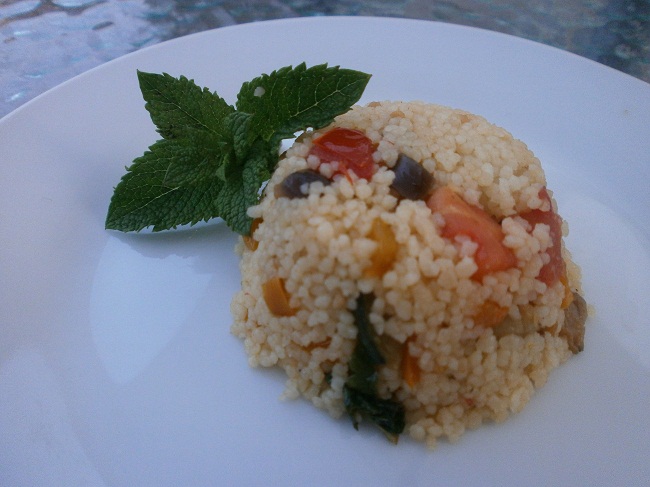
Colors and flavors, it's the cous cous contamination!

0 comments

How do you like some contaminations of cultures, colors and flavors? In the Sicilian cuisine this is possible thanks to a unique dish that is called cous cous! Healthy, colorful, light and fresh, it is perfect for the summer time! 

If we want to match this recipe with a fashion accessory, the perfect one would be the colorful and trendy necklace of this summer. Check it out on Francesca's fashioncooking amazing article. She knows how to combine the two!

A drop of history: As you may already know the cous cous was introduced in Sicily by the North-Africans which still prepare it with mutton meat and cooked vegetables (carrots, onions, peas) so is  definitely more of a winter dish!

In Sicily the most famous cous cous goes with the fish soup. You find it in the western part of the island: Trapani, San Vito, Erice. By contrast in Palermo we have a different version, perfect for veggies we usually cook it with tomatoes, bell peppers, mushroom, aubergine/eggplant, cougette/zucchini and some fresh scented mint. At least this is the recipe I love making, but if you are inspired by other ingredients, you can add them as you like. Once I put olives, rocket salads and mozzarella cheese as well, but this plain version is the one I love the most.

Ingredients & preparation for 6:

400 gr. cous cous
1 cougette/zucchini
1 aubergine/eggplant
1 big bell pepper orange or yellow (or you can use half orange and half yellow)
3 tomatoes
5 medium sized field mushrooms 
a bunch of fresh mint
olive oil
salt

This recipe takes about 2 hours (plus one hour in the fridge). You start with washing your vegs under running water, than cut them in pieces as small as possible. Put the tomatoes aside on a different plate. Once you have all your ingredients in pieces, on a frying pan put a drizzle of olive oil on a medium heat and sauteè all the vegetables except the tomatoes. Stir them from time to time until they become well cooked and golden brown. When they are ready turn the heat off. Wash and chop the mint and add it in the pan together with the tomatoes and then place the mix in a large bowl.

In the same frying pan prepare the cous cous by following the instructions (usually add some water and salt and let cook it for 10 minutes).
Once the cous cous is ready, stir it with a fork to separate the little grains. Let it cool down and finally add it to the veggies in the bowl. Keep mixing all together for about 5 minutes to reach
the "perfect contamination" and put the bowl in the fridge for at least one hour. Serve fresh but not cold.

This dish is so good we even have a Festival to celebrate it every September!
Personally I love it, during summer, because it is perfect for every occasion: for a lunch when you come back from seaside, for a picnic at the park or for a buffet party on the day of your birthday.  


It's fresh and light, easy to make and all these colors will just cheer you up. Enjoy!

THANKS TO ROBERTA FORTE FOR BEING MY MODEL FOR ONE NIGHT ;-)


Sunday, February 3, 2013

"Panelle & Kitchen qb": Sicilian street food introduced by our first guest of the year

0 comments
P like PALERMO, P like PANELLE. 
The two words are forever bond, because the 'pane e panelle' (the panelle sandwich) is together with the other famous 'pane ca' meusa' (the spleen sandwich), the most distinctive and representative street food of the Capital of Sicily. Infact if you ask an Italian about it, I am pretty sure he doesn't know what I am talking about unless he/she has been in Palermo on holiday. If you ask a Sicilian (from another part) he would probably shrug his shoulder too

What eaxctly are they, then? They are fritters made of chickpea flour and water. 
How are they? Flat. Superb. Unique. Delicate. These are only few adjectives to describe the PANELLE and trust me, the average Palermo-dweller is totally in love with them regardless of age, profession or social status.

So... there's no better traditional recipe than this, to guest another food blogger to talk about it. Her name is Silvia and her blog (in Italian language) is called Kitchen qb. It's a lovely, well written and inspiring blog and she is not only a great cook but also an excellent photographer. Now she is in her own words... talking about this dish:

<<Here we go! Let's start talking about street food. My city Palermo is famous for this kind of food, so I can't help talking about one of the most renowned one: the panelle. Introduced by the Arabic domination, this food made of chickpeas flour, water, salt and parsley has its  culmination in the final frying phase because of the superb and tasteful result. 

The panelle are usually placed between a rounded bread bap with sesame seeds on top and it's a treat to stuff the panino with potatoes croquettes as well (in Palermo dialect also called "cazzilli", colorful diminuitive referring to their shape that reminds a part of a male body). 
Where we can find them? Anywhere... in every corner of the city, especially in the "friggitorie" (spots that sell fried food) or at the local peddlers that, with their smell, perfume the entire city.

Ingredients & Preparation:
  • 500 gr chickpea flour
  • 1,5 litre water
  • thinly chopped parsley (as required)
  • e.v. olive oil
  • salt
  • sesame seeds (optional)

1. Fill a large pot with 1 lt water, add the chickpea flour little by little and stir constantly with a whisk to avoid lumps. Put the pot on a medium heat, add a good pinch of salt (about 20 gr.) and keep stirring until it starts boiling and getting thicker.
2. When this mixture will be more solid (similar to the polenta) you can add the parsley and remove from heat.

3. Place the dough on a marble surface previously oiled (or on an oiled oven tray) and flatten it with a spoon or a spatula. Once it has cooled down, with a knife, make some rectangles.
4. Pour some olive oil in a pan on a high heat to start frying our panelle on both sides until golden. 5. Place them on some kitchen paper to absorb the exceeding oil and add a pinch of salt. 6. Serve immediately while still hot, together with little rounded panini.


Note: I only use olive oil for frying, so I suggest to use this one for a better result. Some people also like to squeeze few drops of lemon juice on top and a pinch of black pepper, if you have never tried them, this is about the time.>> 

Silvia

--- Here you can find Silvia's post in Italian language.

Thank you so much to Silvia for being such a lovely guest on my blog. I have to say I do love having panelle with lemon juice on, because its bitterness perfectly combines with the fritters. You can prepare them as starters for a big meal, as finger food on a buffet, or as a proper meal inside a big panino (bread) for a quick lunch on the go, just like Silvia suggested in her recipe and pictures. 

No matter which is the occasion and when you gonna have them, they will blow you away! That's for sure. And vegeterians will love them too! Isn't it amazing?

To make this gorgeous and delicious recipe perfect, let me add a pinch of history: the Arabs that dominated our island from the 9th to the 11th century, were innovators and started to grind the seeds of the chickpeas. The result was flour that, mixed to water and cooked in a pan on a heat, gave a kind of raw dough, that wasn't particularly tasty. But after experimenting they found out that the same dough, cut in thin slices and fried in oil, made a delicious food with an inviting golden color, and little by little, it became very popular. That's how panelle were born.
 

And the love story between them and the city of Palermo lasts ever since.


The pictures are all property of Silvia Crucitti & Kitchenqb, except the pic at the top, taken by Rachel Bajada for the SicilianCuisineBlog; you are not allowed to take or download any of them without asking for permission. Thank you.

Saturday, January 5, 2013

A traditional roast with a Mediterranean touch

0 comments

Do you want to add a Sicilian touch to your traditional roast? Why not? Either you are having turkey, beef or pork for your Sunday dinner, I would like to suggest you a different and very tasty way of cooking the potatoes that will match just perfectly with any meat.

I am talking about this lovely Mediterranean flavored side-dish, perfect to spice up your meal. It is juicy, tasty and creamy. It makes me think of one of my favorite tv shows: "Blue Bloods" (on Cbs), where the Reagan family gather every sunday for lunch. This would be the perfect dish to serve!

Very easy to make, you just need the right ingredients. For 4 people I usually consider 8 medium sized potatoes, plus 2 onions, a can of peeled tomatoes, salt, oregano, black pepper, extra virgin olive oil.

Preparation: 
1. Preheat the oven at 200 C°;
2.
Peel the potatoes, wash them under running water and cut them in big pieces. 3. Peel the onions as well and chop them in thin slices.
4. At the bottom of an oven tray spread some olive oil, place the potatoes and the onion and add the can of peeled chopped tomatoes.
5. Mix all the ingredients very well, then add abundant salt, oregano, a pinch of black pepper and some more oil on top. 6. Place in the oven for about 35-40 minutes (depending on how big the pieces of the potatoes are), but remember to check them and turn them after 15-20 minutes, and then again after 30 minutes.

These are usually the potatoes that you buy here in western Sicily with the chicken roast, so some of you may have recognised them. If you want to propose a new recipe with an old ingredient this is definetely the perfect solution. Enjoy! :-)

Friday, December 14, 2012

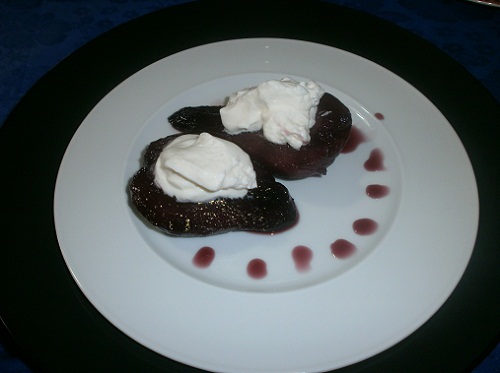
Pears cooked in 'Nero d'Avola' served with whipped cream

0 comments
Do you know how to cook pears in Sicilian red wine and serve them with soft delicious whipped cream? Ok... I will tell you! As Christmas is very close by now, here there is a lovely idea to make a dish with juicy fruits that can also count as a great dessert for one of our upcoming festivities: Christamas Eve, Christamas day, St. Stephen's day (which is boxing day), New Years Eve, Capodanno (New Year day) or Epiphany. See how many occasions we have? 

Infact to be honest... we often forget about fruits when we prepare big meals. We are usually (here in Italy at least) concentrated on the first dish (fresh pasta? baked pasta? lasagne?), the second one (pork? turkey? beef roll?) and the dessert (cake? pie? pudding?), so we tent to miss out the 'fruit course'.

But, if you like the idea, this recipe is elegant and easy at the same time, as you can cook the pears in wine the day before and whip the cream on the big day!!!


Ingredients & Preparation for 4 people: 4 pears cut in halves - 1/2 lt Nero d'Avola (Sicilian red wine) - 200 gr double cream - 200 gr caster sugar - 2 big pieces of lemon zest - cinnamon

1. Wash the pears under running water, cut them in halves and remove skin and inside.
2. Place them in a sauce pan on a medium heat with the red wine to cover them all, plus 100 gr caster sugar, the lemon zest and a sprinkle of cinnamon.
3. Let them cook like this for about 25 minutes, time is also related to the quality of the pears, if they are pretty ripe and soft (but not too much!) probably 15-20 minutes would do, but if they are hard better 30 minutes. You need to check them anyway from time to time!
4. In the meantime whip the cream with the remaining sugar until smooth and soft.
5. As soon as the pears are ready (try them with a fork to test how tender they are) take them out of the sauce pan and place them on a dish to cool down, while keep the sauce going on the heat to restrain a bit more. We are looking at a red wine syrup of some sort that will be poured onto the pears when served so it has to be more juicy than watery.
6. Once the sauce is ready place the pears on a serving tray and the whipped cream in a bowl so that you can serve them separetely. Pour the Nero d'Avola syrup onto the pears and serve straight away.

If you want to try this recipe on a normal Sunday lunch and want to keep it low fat just serve them with plain white yogurth instead of the cream. It will be as delicious as the first one!


Enjoy :-)))


Sunday, September 2, 2012

Light summer minestra: "Pasta with tenerumi"

0 comments

Do you know what "tenerumi" are? And how do we cook them with pasta? Tenerumi which basically means 'tender' are the big leaves of the long green squash, a summer vegetable that is used a lot here in Sicily. Infact this recipe is similar to the one with squash, and they are both pasta a minestra. Do you remember my previous recipe: pasta with squash?


I know what you are thinking: a soup dish with pasta during summer? Isn't it too hot for that? Well... you just have to try them and you will answer to that question by yourself.
Now, to prepare the dish with such vegetable is always difficult to tell the exact amount of tenerumi you need, because here in Sicily you find them wrapped in bunches and their volume can change according to the greengrocer.

Ingredients & preparation for 4 people:
A bunch of tenerumi if big, two if medium size
350 gr. broken spaghetti (Ital. spaghetti spezzati)
4-5 ts of tomato sauce
80 gr. matured caciocavallo cheese cut in small pieces
salt (or a bio stock-cube if preferred)
extra virgin olive oil
 
1 clove of garlic
a small piece of fresh ginger
a small piece of dried red pepper


1. Clean the tenerumi, removing the stems and wash the leaves under running water.
2. Put a pot half full of water on a medium heat.
3. Cut the tenerumi in pieces with a sharp knife and when the water boils add salt (or the stock cube) and drop the tenerumi adding the garlic, the red pepper and the ginger.
4. Let them cook for about 15 minutes.
Now at this point you can choose either to follow the traditional process or instead go with the healthier and faster method, but I can assure you the result is absolutely the same.
In the first case with a slotted or perforated spoon you should take the tenerumi out of the casserole and in another frying pan do the soffritto, putting a drizzle of oil, garlic and then the tenerumi, but what I suggest you do instead is simply: (taking from phase 4 in which everything is cooking together)

5. Drop the spaghetti spezzati inside the casserole and let the pasta cook, then add the table spoons of tomato sauce and stir to mix all together like in the pic on the left.
6. Cook until pasta is perfectly al dente and only when it's ready put the little pieces of matured caciocavallo cheese (pic on the right) and some more extra virgin oil of olive in the pot. Mix together again and serve while hot.

You won't find a simpler, warmer and more familiar dish than this one, especially when the first summer rains start to pour (usually at the end of august/beginning of september here). Enjoy!!! :-)


Wednesday, August 1, 2012

The basics of Sicilian Cuisine: the "Soffritto"

0 comments
The soffritto is the basis and essence of Sicilian Cuisine
Do you know what does "soffritto" mean? This word is one of the most common in cooking Sicilian or Italian style. It actually is both a noun and a past participle for us, referred to the verb "to brown" or "to sautee".

In our cuisine we usually distinguish three different types of soffritto: the principal ingredient of the three is obviously the excellent extra virgin oil of olive. Then we can have (according to the dish we have to prepare) a soffritto made with garlic or a soffritto made with onions. The garlic can be normal or "in camicia", (literally with shirt). It means you can use the clove without removing its skin. This happens usually when it's really late and you don't have a minute to spend for peeling the cloves.
We have some pasta condiments that need garlic, some other onions so it really depends on the recipes, normally we tend to use more garlic for fish and onion for meat.
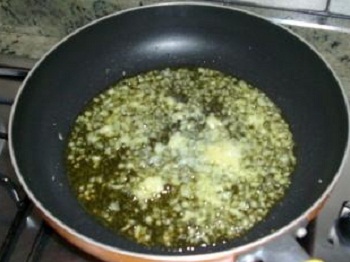
The third one (pic above) is the one that I call the 'mix soffritto' because it is made with a mix of thinly chopped onion, celery and carrots and we use it for long preparations like ragù with minced meat or wherever you need a stronger parfumed soffritto.

Now, it is very important to understand a couple of secrets for the best result of this elementary recipe: (which technically is not a proper recipe but just the first phase of lots of recipes!)
- keep the gas on a medium heat
- do not let the garlic or the onion burn, because we are not frying we are browning so they have to become kind of golden.
- when you cook something like a big piece of meat, prepare the mix soffritto and after 4-5 minutes in which the ingredients are sauteeing and getting golden, add a glass of water and half a glass of white or red wine while the meat is cooking and don't forget some salt and pepper.

So from now on, whenever you find the word "soffritto" you know what you have to do. Have fun :-)

Thursday, July 12, 2012

"Tonnare indietro nel tempo", the new book of Gaetano Basile

0 comments

Yesterday I spent a lovely afternoon in the beautiful "Kursaal Tonnara" (pic above). Tonnara is the Italian name for a specific place and comes from the word tonno that means tuna. Infact that was the place where tuna fish were trapped and killed by the fishermen.

Nowadays all the tuna nets, the tonnare, are closed and eventually became something else just like this one that is a place for events, concerts and presentations. And infact just there was presented the new book of Gaetano Basile, journalist and local institution for everything regarding the history of Sicily and the Sicilian food and cuisine. 


His latest book talks about the historical places that were the tonnare, about tuna and about fish in general and has got several recipes too. The title is: "Tonnare indietro nel tempo", which means tonnare back in times. 

I couldn't miss this great event and the pleasure of listening to the story of this traditional places that made our wonderful island special for so many centuries. So thanks Mr. Basile for all you do and your great passion you put into it. Very inspiring!!!


If you want to know more about Prof. Basile you can have a look at his Italian website:
Spaghetti italiani


Sunday, July 1, 2012

A white focaccia with onions: can I please have some more?

0 comments

Do you know how to prepare a lovely rustic white focaccia with white onions and caciocavallo cheese? (We call it white because there is no tomato sauce.) Apart from the bread itself to prepare this recipe you will need:  high quality extra vergin olive oil, salt, oregano, 2 white onions, 50 gr. caciocavallo cheese (Sicilian local cheese).

First of all, to make the focaccia bread: you can prepare it on your own by following this simple recipe unless you can find a very good dough ready to be cooked in a deli or market. Follow the instructions, then, while the dough is rising, cut in rings and scald the onions and cut also the caciocavallo cheese in little cubes. 
With your thumb do little imprints into the dough and brush some olive oil on top, the onions rings previously scalded, the cheese in cubes, a little salt because the cheese is very tasty and finally sprinkle with oregano.


Put in the oven at 180°c (should be 425 degrees) for about 15-20 minutes. Have a look at the bottom to be sure that under is brown and not white. If too pale let it cook for 5 more minutes until golden brown. 

That's it!!! You made your lovely white mediterranean focaccia! Now you just have to eat it and enjoy, and you will agree with me... it won't be enough!!! :-)

Sunday, April 29, 2012

Sicilian mandarine and orange jelly: light and refreshing!

0 comments
Do you know how to make a lovely parfumed Sicilian mandarine and orange jelly? This is the easiest thing in the world, it's delicious and perfect to refresh your mouth especially after having eaten a big meal and it's the best way to give vitamin C to your kids when they are too lazy to peel an entire orange!

Ingredients and preparation for 4 people:
1/2 liter of fresh mandarine and orange juice (about 6 mandarines and 8 oranges, but really depends on how big and juicy they are)
2 spoons of sugar
25 gr. fish glue


First of all, you need to obtain 1/2 liter of fresh mandarines and oranges juice, so you have to squeeze them carefully removing the pulp afterwards. If the juice is already mixed to a large quantity of pulp you can use a small colander to strain the juice.
Once you have your half liter, leave it aside for few minutes and in a medium sauce pan put a glass of water at room temperature and the thin sheets of fish glue. This is an eatable substance that looks like a small 
transparent sheet of paper. When you buy it, is hard, then you leave it 10 minutes in the water and becomes like jelly.
Once it is so, on a medium heat put your sauce pan with the fish glue that has melted in the water and stir slowly, it will melt completely!

Now it's the time to add our lovely squeezed juice and keep stirring. When the juice is still liquid but hot (it doens't have to reach the boiling phase) we can remove it from the heat and pour it in our bowl and let it cool off, stirring from time to time.

As soon as it's cold let's put it into the fridge and leave it there for at least 3 hours. After one hour or so, go and check if the "thing" is actually becoming a real jelly. Normally it sure does and you can enjoy the freshness and lightness of our Mediterrenean fruits. Enjoy!

Ps - Don't forget that if your oranges are particularly sweet or you just try to avoid sugar as much as possible, you can eliminate it, I prepared it many times without it and the result is still excellent!

Saturday, March 24, 2012

A delicious spring pasta: Bronte's pistaches pesto & speck

0 comments

Do you know what the pesto of pistaches is? It is a sauce made of mashed pistaches from Bronte, a town near Catania, and it is mixed with some salt, pepper and oil of olive. It is a product that people normally buy in supermarkets but I don't think you find it anywhere else out of Sicily.

The recipe that I am going to put is something my mum and I created on a sunday morning, while we were thinking about an original nice way to dress our pasta. We like to try combining different ingredients so we decided to use not only a Sicilian pistaches pesto but also some speck, which is a smoked Parma ham typical of the region of Trentino Alto Adige, up in the north, added some creamy cheese as well and it was just fabulous! We couldn't have a better result! 
So with a little more imagination we can say that Italy is united in this dish also in our three colors of the flag :) 

Ingredients & preparation for four people:
380 gr. penne rigate (or any other type of pasta you like)
4-5 tablespoons of pesto
80 gr. speck thinly sliced and chopped in pieces
2-3 tablespoons of creamy cheese (like Philadelphia or similar)
3-4 leaves fresh mint
some grated lemon zest
black pepper

Cook the penne as usual, adding salt when the water boils. While they are cooking, in another sauce pan or frying pan, put the chopped speck on a medium heat, after a couple of minutes add the pesto of pistaches and some hot water taken from the pasta, add the creamy cheese as well, a bit of black pepper, the leaves of mint and some grated lemon if you like them all and... voilà the sauce is ready!
As soon as the penne are cooked, drain and sautè them in the sauce pan with the dressing, mixing well all together. Sprinkle with Parmisan cheese on top and the whole of Italy is served right on your table! Delicious!!!

Friday, March 2, 2012

Exquisite fava beans mash: the Sicilian "maccu"

0 comments
Do you know what is the so-called "MACCO DI FAVE"? In Sicilian the word macco becomes maccu and is used to name an exquisite dish we prepare with dried and peeled fava beans. It is a mix between a thick soup and a puree, because when you cook fava beans they mash up and become an homogeneous soup. You can also have it with pasta, as one of our 'minestra'.


Here comes the recipe for 4 people:

250 gr dried peeled fava beans
3 ts tomato sauce
a small bunch of wild fennel (like 20% of the one in the pic)
3 ts extra virgin oil of olive
hot chili pepper (a little piece or half of it)
salt


Preparation:

First of all, wash the fennel under running water. In a pot on a medium heat put some water (about 1 litre) with the fava beans. As soon as the water starts to boil add salt, fennel cut in small pieces and half of a little chili pepper and reduce the heat at the minimum.
Let the beans cook slowly, stirring from time to time so that they don't get stuck at the bottom. To obtain the mash they have to cook about one hour all together, but it also depends on how water you put. If it's too much wait until the majority of it is absorbed by the fava beans. 
After the first 25 or 30 minutes, add the spoons of tomato sauce and olive oil. Finally, serve hot with grilled slices of rustic bread spread with a clove of garlic.

It's simple, it's healthy and delicious, everyone loves it and is also perfect for vegeterians. Can we ask for more? :-))

Tuesday, February 21, 2012

The period of Carnival: costumes and sweets galore!

0 comments

Do you know what the Italian Carnival is? The Carnival in Italy is the period of festivity dedicated to the children and it always comes before the Lent, the forty days of Penitence that lead to Easter. In Sicily the most famous Carnival festivities are in Acireale (near Catania, the pic above), in Sciacca (near Agrigento), and in Termini Imerese (near Palermo). Normally people, above all kids, wear particular costumes, so it's quite common in these days to see walking little Supermen, cowboys, Robin Hoods or princesses along the street with their parents. So cute! 
At the table the Carnival is the period in which you really can get fat and enjoy food, infact traditional sweets are usually fried and we call it with a general word: "frittelle".  Frittelle means something sweet and fried.


To be more specific though, we have lots of stuff that we prepare: the most renowned in the whole of Italy are definetely the 'CHIACCHIERE', that means 'chats'. This crunchy sweets are called so because you eat one after the other while chatting.

By the way, I have to warn you that even if they are made all over the country in every region of Italy have a different name (cenci, galani) and shapes (rectangular, little knots), which is interesting but sometimes a bit confusing. In Sicily we call it chiacchiere and especially if homemade, they are delicious, because we add some parfumed liquoer, Marsala is usually the best and make them really special!

Here comes the recipe:
200 gr flour - 2 eggs - 20 gr caster sugar - 20 gr soft butter - 2 spoons of Marsala - a pinch of salt - oil of olive for frying.
In a bowl mix the flour with all the other ingredients: salt and sugar, butter and Marsala, then the 2 eggs previously beaten. Make the dough little by little, until it becomes elastic and homogeneous. Give it the shape of a ball, wrap it up with a kitchen cloth and leave it aside for about 30 minutes. Then, using the rolling pin, roll it out, but not too thick, about 1/2 cm. Now, you can cut it and make all the shapes that you want.
In a frying pan put some olive oil, when is hot enough fry the chiacchiere until they become gold-ish. Finally sprinkle icing sugar on top and serve still warm. You will chat a lot! Ahah... just exquisite!

 
ban nha mat pho ha noi bán nhà mặt phố hà nội