Showing posts with label sicilian desserts. Show all posts

Friday, December 14, 2012

Pears cooked in 'Nero d'Avola' served with whipped cream

0 comments
Do you know how to cook pears in Sicilian red wine and serve them with soft delicious whipped cream? Ok... I will tell you! As Christmas is very close by now, here there is a lovely idea to make a dish with juicy fruits that can also count as a great dessert for one of our upcoming festivities: Christamas Eve, Christamas day, St. Stephen's day (which is boxing day), New Years Eve, Capodanno (New Year day) or Epiphany. See how many occasions we have? 

Infact to be honest... we often forget about fruits when we prepare big meals. We are usually (here in Italy at least) concentrated on the first dish (fresh pasta? baked pasta? lasagne?), the second one (pork? turkey? beef roll?) and the dessert (cake? pie? pudding?), so we tent to miss out the 'fruit course'.

But, if you like the idea, this recipe is elegant and easy at the same time, as you can cook the pears in wine the day before and whip the cream on the big day!!!
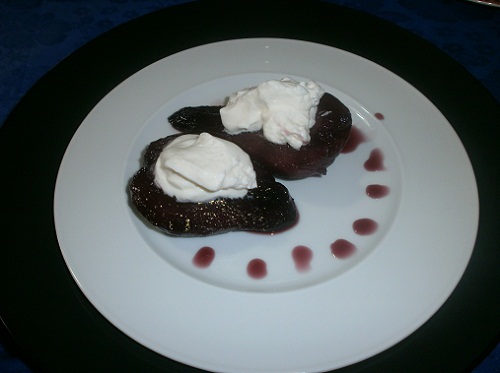

Ingredients & Preparation for 4 people: 4 pears cut in halves - 1/2 lt Nero d'Avola (Sicilian red wine) - 200 gr double cream - 200 gr caster sugar - 2 big pieces of lemon zest - cinnamon

1. Wash the pears under running water, cut them in halves and remove skin and inside.
2. Place them in a sauce pan on a medium heat with the red wine to cover them all, plus 100 gr caster sugar, the lemon zest and a sprinkle of cinnamon.
3. Let them cook like this for about 25 minutes, time is also related to the quality of the pears, if they are pretty ripe and soft (but not too much!) probably 15-20 minutes would do, but if they are hard better 30 minutes. You need to check them anyway from time to time!
4. In the meantime whip the cream with the remaining sugar until smooth and soft.
5. As soon as the pears are ready (try them with a fork to test how tender they are) take them out of the sauce pan and place them on a dish to cool down, while keep the sauce going on the heat to restrain a bit more. We are looking at a red wine syrup of some sort that will be poured onto the pears when served so it has to be more juicy than watery.
6. Once the sauce is ready place the pears on a serving tray and the whipped cream in a bowl so that you can serve them separetely. Pour the Nero d'Avola syrup onto the pears and serve straight away.

If you want to try this recipe on a normal Sunday lunch and want to keep it low fat just serve them with plain white yogurth instead of the cream. It will be as delicious as the first one!


Enjoy :-)))


Saturday, May 28, 2011

"Cassata al forno", the most tempting Sicilian baked pie with the famous sweet ricotta cream filling

0 comments
Do you know what the "Cassata al forno" is? The Cassata is a lovely baked pie filled with a delicious cream made of ricotta cheese and chocolate chips. You can either prepare a big one or if you prefer some mini-pies just like the ones in the picture below on the right.
 

Before carrying on with the recipe it's important to make some preliminary remarks. The Cassata is the most traditional dessert made in Sicily together with the famous cannoli.


Thanks to a very renowned line of the movie "The Godfather"... "leave the gun, take the cannoli", almost every person in the planet has an idea of what cannoli look like.


But what about the Cassata? We have two different kinds of Cassata that we call: the classic one, the Sicilian Cassata (cassata siciliana) and the baked cassata (cassata al forno). 
While the first is famous for its cover of icing and colored candied fruits and it is made of green marzipan on the sides (just like shown in the pic on the left) the second one, which is the most ancient, has got exactly the same filling but it's simpler because it is just a baked pie. (See the main pic on top or the one below on the right).
Nowadays you can find both all year long, but remain traditional of big important festivities like Christmas and Easter.


The origins of this dessert with ricotta cream go probably back to the Arabic domination (IX- XI centuries), but the version with marzipan and candied fruits was created more recently in the middle of XIXth century from a patisserie chef named Gulì.

About the etimology of the word cassata is still uncertain. Some people think that comes from the Arabic qas'at, that was the rounded bowl or basin where the cassata was prepared, that gives it that particular shape, some others think comes from the latin caseus, that is cheese, probably in reference to the ricotta cheese that fill the pie.

To prepare about 10 mini-pies or just one big baked pie instead, you will need:

For the dough
500 gr flour - 
200 gr lard - 100 gr caster sugar - 2 eggs + 2 yolks - half glass of Marsala wine - a pinch of salt


1. Let soften the lard out of the fridge, then mix it with the sugar until the result is smooth and soft.
2. On a surface put the flour and making a well put inside the mix of lard plus eggs, some of the Marsala and the pinch of salt. 3. Mix well all the ingredients until you have a soft dough. In case is a bit hard, add the other Marsala, then make a ball and place in the fridge for about an hour. 

For the ricotta cream
500 gr sheep fresh ricotta cheese - 300 gr sugar - 80 gr dark chocolate chips - 60 gr zuccata (which is a candied kind of big zucchini or cougettes) - cinnamon in powder - icing sugar - (In addition lemon zest if liked).

1. Sift the ricotta cheese in a sieve and mix it with the sugar. 2. Stir until it turns very soft and creamy, then add some dark chocolate 
chopped in small pieces (or chocolate chips if you have) and cinnamon to parfume the cream. 3. If you like it, cut the piece of zuccata in tiny cubes and mix them to the cream. Its taste is very delicate.
4. Now prepare the pie as usual, dividing the dough in two parts, one a bit bigger for the bottom part. 5. Roll out the first half of the dough on the special cassata tin, giving a rounded shape, fill with the ricotta cream and cover with the second half of pastry, that has to be flat.
6. Careful in sealing the sides of the pastry well, so that the cream inside won't come out with the heat of the oven.
7. Bake for about 45-50 minutes at a temperature of 180° C. It obviously has to be brown.
8. When is ready and has cooled down a bit, sprinkle with icing sugar and cinnamon powder if you like. Usually here in the patisserie you find a checked or a rhombus decoration done with sugar and cinnamon.


If you have some left-over place it in the fridge, it will be still perfect for the following 2 or 3 days (especially if your ricotta cheese was really fresh!) and you will be able to enjoy it for more than just one day!

Monday, March 28, 2011

Genovesi from Erice, the perfect marriage between pastry and cream

0 comments

Do you know what a genovese is in Sicily? It is a pastry filled either with ricotta cream or a very delicate milky-custard cream. The most famous genovesi, at least in the western part of Sicily, are the ones made in the medieval village of Erice, in the province of Trapani. They are delicious, soft and tasty, especially if eaten warm. Here there is the recipe of the genovesi made by the famous Patisserie of Maria Grammatico in Erice.

Ingredients and preparation: 
Pastry
250 g hard wheat flour
250 g flour 00
200 g sugar
200 g butter or margarine cut in pieces
4 yolks
Some table spoons of cold water
icing sugar to sprinkle on top

Filling:
2 yolks
150 g sugar
40 g starch (wheat or corn)
½ lt milk
grated lemon zest

Pastry preparation:
1. Mix both the two flours with the sugar in a large bowl.
2. Add the pieces of butter, then the yolks one after another, stirring slowly with a professional spatula. 3. Add the water until the pastry is soft and elastic. 4. Form a ball without kneading too much otherwise it will get hard. 5. 
Wrap the pastry in plastic and place it in the fridge for at least 30 minutes. 6. Roll it out giving them an oval shape, like shown in the picture.

Cream preparation and baking
1. Preheat the oven at 200° degrees. 
2. In a bowl beat the yolks with the sugar using a whisk. 
3. In a sauce pan on a low heat melt carefully the starch in a half glass of milk, then add the remaining milk and mix well. 
4. Pour the mix of yolks and sugar into the milk slowly. Keep stirring for 10-15 minutes, until it becomes solid and smooth. Add the grated lemon zest. 
5. Once ready put the cream in a bowl and let it cool down. 
6. Once is cold take a couple of spoons of cream and fill the oval shaped pastries, one after another (about 2 cm in diameter). Then stick together the two parts giving the shape of half moon, like in the picture. 
7. Once they are all filled, place them on an oven tray and bake them for 8-10 minutes (200° C) at the most. You should have about 15 genovesi. 
8. Finally, sprinkle with icing sugar and serve while still warm. Enjoy!

Sunday, February 6, 2011

"Happy birthmonth" to the Sicilian Cuisine blog

0 comments

Yesterday I went out for dinner with two friends of mine. I wanted to talk to them as I have just lost my job, so the occasion was a bit sad. Fortunately we laughed a lot and had a lovely dinner in a Trattoria with some typical dishes like the caponata, done in the apples version, which was one of my favourite things. The homemade pasta was also very nice, especially the walnut cream on top.

Then the dessert arrived. It was the very famous "torta Setteveli", which means seven layers cake. Created in Palermo by the Maestro pastry Chef Cappello has now become very popular during birthdays and parties. So, because today my "baby" is one month old, I thought it would be nice to celebrate it with this post, hoping that the future will be professionally brighter thanks also to this blog.

 
ban nha mat pho ha noi bán nhà mặt phố hà nội