Tuesday, December 13, 2011

Santa Lucia & the tradition: let's find out what when & why

0 comments
Do you know why on December the 13th which is the day of the Sicilian Virgin and Saint Lucy here in Sicily we eat some stuff called: "cuccìa", "panelle" and above all "arancine"? Let's make it clear once and for all :)

The story has got ancient roots: in the XVIIth century the city of Palermo and probably all the areas around were suffering from a terrible famine; people were starving and had nothing to eat, so they started to pray Saint Lucy who was originally from the Sicilian town of Siracusa. On the day of her festivity in 1646 (during the period of famine) a huge ship arrived in the harbour of Palermo and it was full of wheat.


People were so hungry that use the grain just as it was, boiled and eaten it with the few things they had like oil of olive, ricotta and vegetables. 

Little by little the tradition of cooking the wheat in grains spread on that day and people started to make also a sweeter version which in Sicily has always to be with ricotta cream. The name of this dish is "cuccìa(the pic above is the sweet cuccìa), probably coming from the word "cocciu", which literally means grain. So this day is the only day of the year in which pasta and bread are banned from Sicilian tables to remind us the story of this miracle.

Now, having banned all the food made of wheat people had to eat other stuff apart from the cuccìa, so they started to eat potato pies, panelle which are chickpea fritters (the pic above), also in their sweet version filled with little custard and caster sugar on top (see the pic here on the right).

But the food that the majority of Palermo citizens relate to this day are the unique "arancine", scrumptious fried rice balls filled with different ingredients: ham & mozzarella cheese or minced meat ragout (the classic ones) but today you also find them with spinach, salmon and sometimes chicken as well.  
Hence, although it started like a day of penitence today by contrast it is popularly known as "the day of arancine", in which the "average palermitano" stuffs himself with 5 or 6 (and sometimes 8,9,10!!!) rice balls, and probably, if you ask him/her why there is no bread or pasta he/she doesn't even know how to answer.

 I am a huge fan of traditions, but I think it's important to know their stories and where they actually come from, so if you wanna try an arancina, or a sweet panella or some cuccìa on this very special day for us, feel free to do so, but at least you know why!

Tuesday, November 15, 2011

Oregano and lemon zest, two things I cannot live without!

0 comments

Give me some pizza and I will put a ton of oregano on it. Ask me to make a sweet pie with ricotta cheese (our traditional cassata) and I will grate some lemon zest inside. If I prepare some healthy steamed cabbage as side-dish and a beef steak I will sprinkle both of them with some oregano and if I cook a plate of pasta alla carbonara or pasta with smoked salmon... here we go again I must have some lemon zest.

I could go on and on and on but I think I made myself quite clear. There isn't another ingredient in the kitchen that I love to taste more than these two when I eat. They both have such a Mediterranean delicate but fabulous smell and are able to turn a good dish into a superb one because of their parfume! Isn't it amazing?

Another reason why I love them it's... I guess that for me they are just home! I like trying different cuisines and new ingredients but when I have something with oregano or lemon zest... that's just where I belong to.

Yesterday by the way, I was watching a tv show about cookery where there was a Sicilian chef. He was preparing some chicken legs cooked in beer with rosemary and garlic, and.... guess what did it put on top of it? Lemon zest! So it's good to know I am not the only one crazy about it :)

Tuesday, November 1, 2011

Sicilian November tradition: "frutta di Martorana & pupi di zucchero"

0 comments

In Sicily and in particular in Palermo there are two important festivities that come on the beginning of November. On the very 1st of the month we celebrate All Saints' day, which is a religious day dedicated to the Saints, so it's important if we want to ask them help or pray for intercession. The 2nd of November is All Souls' day and is dedicated to the loved ones that we lost and it's a completely different thing.

When we were kids, the 2nd of November was an important awaited day, because parents used to tell children that during the night a deceased relative of the family came on that special day of the year to visit them and bring gifts plus many delicious sweets for the little ones. It was called "u cesto di morti", which means the basket brought by the deads! The children had to be very careful, if the deads arrived while they were still awake, they would tickle their feet. Another sweet gift that they used to bring were the famous precious "pupi di zuccaro", beautiful dolls made only of sugar (pic on the right).

But the most renowned sweets that we make for this occasion is the famous "Frutta di Martorana", which means marzipan made with almond flour and shaped in any kind of fruits and vegetables (pic above). The name comes from the Nuns of the Monastery of Martorana, nearby the same Church, who were the ones that used to prepare these fruits on the 1st of November. These fruits are also called "Pasta reale", which means royal pastry, because was often appreciated by many kings during the centuries and is exactly the same that we use on Easter day for representing the Lamb.

Nowadays, it has become more and more difficult to keep this tradition alive, due to the Hallowen influence on our culture. We want to keep this recurrence alive in our own way, thinking that all Souls' Day is not only a commemoration of the deads, but also a real celebration of their lives. They are not with us anymore in body, but we believe they keep staying close and although is sad, we want our children to remember them with a smile, not with fear. Nothing to be afraid of, because without death there wouldn’t be any life and viceversa.

Thursday, October 20, 2011

Filled bell peppers: gorgeous Mediterranean taste

0 comments

Do you know how to make some bell peppers filled with cheese and olives? This is a typical Sicilian side-dish and it has definetely got a great Mediterranean taste. There are several fillings for these vegetables, but I like to do a simple one, not long, nor difficult.


Ingredients & preparation for 4 people:
2 bell peppers
80 gr. green pitted olives
150 gr. Sicilian primo sale cheese
4-5 ts breadcrumb
3 ts tomato sauce
e.v. olive oil
oregano
salt


1. Cut the bell peppers in half, remove the inside and the seeds and wash them under running water.
2. Switch the oven on at a temperature of about 180° C.

3. In a bowl or a large dish put the breadcrumb and mix it with the olive oil, the tomato sauce, a pinch of salt and the olives cut in halves or even better in slices. Sprinkle with abundant oregano.
4. Now cut the cheese in cubes.

5. In an oven dish, put a drizzle of oil at the bottom and with a spoon start filling the pepperoni one at a time, first with the breadcrumb mix and then topping with the cubes of primo sale cheese (or any other tasty cheese you like).
6) Place them in the oven dish and let them cook for about 30 minutes or so. Better if you check after 20 minutes and see how the cooking is going, the cheese must melt and the bell peppers have to be quite soft.

Serve them when they are getting warm, it will be the perfect moment because you can appreciate the different flavours of the dish without burning your mouth. This is a typical Mediterranean recipe, also perfectly suitable for vegeterians and I really hope you can enjoy it!

Tuesday, October 4, 2011

What do Sicilians eat for breakfast?

0 comments
Do you know what Sicilians usually eat for breakfast? When I decided to create a food blog I loved the idea of posting not only mere recipes, but also stories, origins and any other information that can be interesting about our way of eating and our habits. So that is what this article is about: our breakfast!
 
As Sicily is a part of Italy (can't stand those who say the opposite only because it's an island!), Sicilian breakfast at home is like the Italian one: strong black coffee, with or without milk, with few biscuits or some sliced bread with butter and jam, possibly homemade. But if you do have breakfast out things change. It's still true we can't live without the black espresso from the bar or the lovely cappuccino, we also love fresh orange juice (squeesed in that moment!) and we usually have some delicacies with those things.
The most traditional ones in Palermo and its province are: treccine (twist shaped), millefoglie, ciambelle and brioche; (up above the picture of a ciambella and a treccina).
(You'll also find the international croissants and similar stuff such as Danish pastries with cream and apple, ecc... like in the rest of the world I suppose.)
 
The dough of this four things are similar one another, the first two treccine and millefoglie (here on the left a millefoglie) are baked and have sugar on top, they only have different shapes, plus the millefoglie has got raisins as well. Ciambelle (pic on top) are fried and very similar to donuts, at least in their shape, but are bigger, softer and with caster sugar. Needless to say they are the best and all the kids love them!
I remember when I was a child and I had to go to the doctor for blood exams with my empty stomach, after that horrible experience (as a kid) only a big soft rounded ciambella could make me smile again!!! :-)))
Finally there are the briosce or brioche, the word comes from the French. Careful when you use this word in other parts of Italy because in the north (like in Milan) they call briosce a normal croissant, while we don't because as I've just explained for us are to different things!

Our brioches are plain baked buns (oval or rounded like here on the right) and we eat them in many different ways: you can have an empty brioche with your cappucino in the morning, then a briosce with ham and tomato for lunch, and even a brioche with ice cream for dinner or during the afternoon! This is how Sicilians love to eat their ice cream in Summer!!! They are suitable for every need :)))
Talking about the hot season I have to add that there are many Sicilians who prefer to have a lemon granita (I think the correct translation should be shovel or ice shaved) with the brioche instead of the hot cappuccino in the Summer mornings, but this is up to everyone's taste and habit. I like my cappuccino even in the middle of July!

So now you can understand a little bit more about our first meal, and when you come to Sicily you will definetely know what to ask for breakfast!

Friday, September 30, 2011

Pasta with squash, our summer & fall "minestra"

0 comments

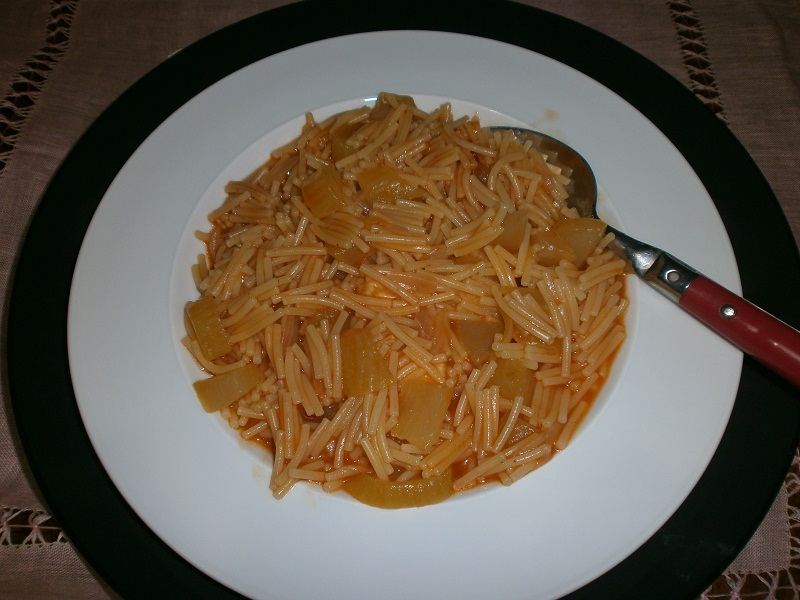
Do you know how to cook "pasta con la zucchina a minestra"? I already told you about pasta a minestra in general, now we are preparing a specific minestra with squash. This is a great summer and autumn dish.

I know I know, everyone thinks that in summer you only have to eat cold or refreshing food, but Sicilian tradition do not agree with that. Infact in Summer we also prepare some types of pasta made with broth, like a soup, and this is exactly one of them. You may not have it too liquid (like it is in the pic above, but that depends only on your personal taste!) Even better is having it in this season, when the first rains arrive.

Ingredients & preparation for 4 people:
1 half of a squash (if very long)
1 small onion
400 gr. broken spaghetti (Ital. spaghetti spezzati)

4-5 ts of tomato sauce
80 gr. matured caciocavallo cheese in small pieces
salt (or a bio stock-cube if preferred)
olive oil
a small piece of dried red pepper

1. You peel the squash (pic on the left), cut it in half and then in thin slices. 2. On a medium heat put a large pan with half the water. 3. As soon as the water boils put salt (or a bio stock-cube if preferred), onion and the squash in pieces. 4. After about 12-14 minutes put the pasta and the tomato sauce. For this dish we use the "spaghetti spezzati" type of pasta, which are simply broken spaghetti.
5. When the pasta is almost cooked (usually after 10-12 minutes) put the little pieces of caciocavallo cheese inside the soup, so that they have the time to melt a bit (matured caciocavallo is very hard).This local cheese is very salty and tasty, so is the perfect contrast with the delicate taste of the squash.

If you want to try this lovely pasta don't hesitate: it's simple, healthy and tasty. Perfect for vegeterians or even health food nut people :) Enjoy!

Thursday, September 22, 2011

Fresh homemade tomato sauce: it's worth doing it!

0 comments
Do you know how to make a fresh delicious homemade tomato sauce? Have you ever tried?

The making of tomato sauce (in Italian salsa di pomodoro) definetely reminds me of my childhood summers spent in our country-house along with my family and my maternal grandparents.

My mum and my grandma sometimes were doing the "salsa" (literally means sauce and when we say the word alone it only means tomato sauce). I used to watch the process, not the entire one though, as it was very long and after a while I inevitably got bored; so I was coming and going from the kitchen from time to time.


Last week after so many years I decided to prepare once again some fresh tomato sauce. Contrary to what I used to think when I was 10, it didn't seem to me neither long nor boring. That's good! 
It took me just an afternoon (cooking time included) and the result was great! I was so proud :-)

Ingredients:
1 kg ripen tomatoes

1 onion
1 full teaspoon of salt
1/2 spoon of caster sugar

black pepper
olive oil
fresh basil
cinnamon in powder
nutmeg

1. Wash the tomatoes under running water, then roughly cut them and put them in a sauce pan together with the sliced onion. Let cook the two together for about 30 minutes on a very low heat with a lit.
2. After that
 it's time to mash them up. To help you speed up the process you can first blend the mix; this will facilitate the squeezeing phase. 
3. To squeeze them put them in a strainer. I have an electric tomato strainer (or squeezer... I am not sure how you exactly call it) so it's very easy (See the pic here on the left). When you have finished the squeezing phase, the liquid that you have gathered in the sauce pan is very watery and needs to be reduced to the proper thickness of the tomato sauce, so it has to cook again on a very low heat for at least two hours and half or until it is not watery anymore.


4. As soon as the liquid is becoming more and more "sauce" than water add all the ingredients to make it tasty: salt, sugar, a pinch of black pepper, nutmeg, cinnamon and some fresh leaves of basil. Taste it and adjust with salt and sugar if needed.

In the end add also a drizzle of extravergin olive oil... and that's pretty much it, your fresh homemade tomato sauce is ready!!!
You can use it on your pasta, bruschettas, pizza or wherever you like. You will be proud too! ;-)


Enjoy!
 
ban nha mat pho ha noi bán nhà mặt phố hà nội