Tuesday, October 4, 2011

What do Sicilians eat for breakfast?

0 comments
Do you know what Sicilians usually eat for breakfast? When I decided to create a food blog I loved the idea of posting not only mere recipes, but also stories, origins and any other information that can be interesting about our way of eating and our habits. So that is what this article is about: our breakfast!
 
As Sicily is a part of Italy (can't stand those who say the opposite only because it's an island!), Sicilian breakfast at home is like the Italian one: strong black coffee, with or without milk, with few biscuits or some sliced bread with butter and jam, possibly homemade. But if you do have breakfast out things change. It's still true we can't live without the black espresso from the bar or the lovely cappuccino, we also love fresh orange juice (squeesed in that moment!) and we usually have some delicacies with those things.
The most traditional ones in Palermo and its province are: treccine (twist shaped), millefoglie, ciambelle and brioche; (up above the picture of a ciambella and a treccina).
(You'll also find the international croissants and similar stuff such as Danish pastries with cream and apple, ecc... like in the rest of the world I suppose.)
 
The dough of this four things are similar one another, the first two treccine and millefoglie (here on the left a millefoglie) are baked and have sugar on top, they only have different shapes, plus the millefoglie has got raisins as well. Ciambelle (pic on top) are fried and very similar to donuts, at least in their shape, but are bigger, softer and with caster sugar. Needless to say they are the best and all the kids love them!
I remember when I was a child and I had to go to the doctor for blood exams with my empty stomach, after that horrible experience (as a kid) only a big soft rounded ciambella could make me smile again!!! :-)))
Finally there are the briosce or brioche, the word comes from the French. Careful when you use this word in other parts of Italy because in the north (like in Milan) they call briosce a normal croissant, while we don't because as I've just explained for us are to different things!

Our brioches are plain baked buns (oval or rounded like here on the right) and we eat them in many different ways: you can have an empty brioche with your cappucino in the morning, then a briosce with ham and tomato for lunch, and even a brioche with ice cream for dinner or during the afternoon! This is how Sicilians love to eat their ice cream in Summer!!! They are suitable for every need :)))
Talking about the hot season I have to add that there are many Sicilians who prefer to have a lemon granita (I think the correct translation should be shovel or ice shaved) with the brioche instead of the hot cappuccino in the Summer mornings, but this is up to everyone's taste and habit. I like my cappuccino even in the middle of July!

So now you can understand a little bit more about our first meal, and when you come to Sicily you will definetely know what to ask for breakfast!

Friday, September 30, 2011

Pasta with squash, our summer & fall "minestra"

0 comments

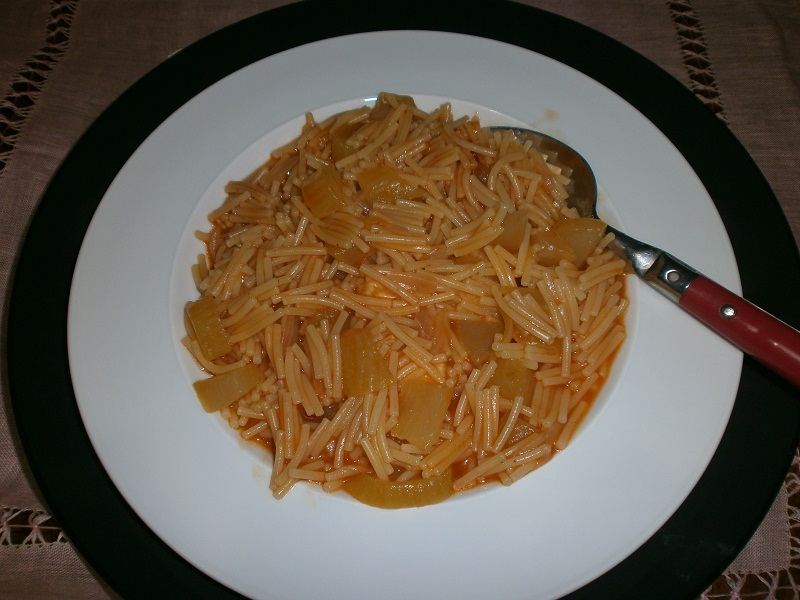
Do you know how to cook "pasta con la zucchina a minestra"? I already told you about pasta a minestra in general, now we are preparing a specific minestra with squash. This is a great summer and autumn dish.

I know I know, everyone thinks that in summer you only have to eat cold or refreshing food, but Sicilian tradition do not agree with that. Infact in Summer we also prepare some types of pasta made with broth, like a soup, and this is exactly one of them. You may not have it too liquid (like it is in the pic above, but that depends only on your personal taste!) Even better is having it in this season, when the first rains arrive.

Ingredients & preparation for 4 people:
1 half of a squash (if very long)
1 small onion
400 gr. broken spaghetti (Ital. spaghetti spezzati)

4-5 ts of tomato sauce
80 gr. matured caciocavallo cheese in small pieces
salt (or a bio stock-cube if preferred)
olive oil
a small piece of dried red pepper

1. You peel the squash (pic on the left), cut it in half and then in thin slices. 2. On a medium heat put a large pan with half the water. 3. As soon as the water boils put salt (or a bio stock-cube if preferred), onion and the squash in pieces. 4. After about 12-14 minutes put the pasta and the tomato sauce. For this dish we use the "spaghetti spezzati" type of pasta, which are simply broken spaghetti.
5. When the pasta is almost cooked (usually after 10-12 minutes) put the little pieces of caciocavallo cheese inside the soup, so that they have the time to melt a bit (matured caciocavallo is very hard).This local cheese is very salty and tasty, so is the perfect contrast with the delicate taste of the squash.

If you want to try this lovely pasta don't hesitate: it's simple, healthy and tasty. Perfect for vegeterians or even health food nut people :) Enjoy!

Thursday, September 22, 2011

Fresh homemade tomato sauce: it's worth doing it!

0 comments
Do you know how to make a fresh delicious homemade tomato sauce? Have you ever tried?

The making of tomato sauce (in Italian salsa di pomodoro) definetely reminds me of my childhood summers spent in our country-house along with my family and my maternal grandparents.

My mum and my grandma sometimes were doing the "salsa" (literally means sauce and when we say the word alone it only means tomato sauce). I used to watch the process, not the entire one though, as it was very long and after a while I inevitably got bored; so I was coming and going from the kitchen from time to time.


Last week after so many years I decided to prepare once again some fresh tomato sauce. Contrary to what I used to think when I was 10, it didn't seem to me neither long nor boring. That's good! 
It took me just an afternoon (cooking time included) and the result was great! I was so proud :-)

Ingredients:
1 kg ripen tomatoes

1 onion
1 full teaspoon of salt
1/2 spoon of caster sugar

black pepper
olive oil
fresh basil
cinnamon in powder
nutmeg

1. Wash the tomatoes under running water, then roughly cut them and put them in a sauce pan together with the sliced onion. Let cook the two together for about 30 minutes on a very low heat with a lit.
2. After that
 it's time to mash them up. To help you speed up the process you can first blend the mix; this will facilitate the squeezeing phase. 
3. To squeeze them put them in a strainer. I have an electric tomato strainer (or squeezer... I am not sure how you exactly call it) so it's very easy (See the pic here on the left). When you have finished the squeezing phase, the liquid that you have gathered in the sauce pan is very watery and needs to be reduced to the proper thickness of the tomato sauce, so it has to cook again on a very low heat for at least two hours and half or until it is not watery anymore.


4. As soon as the liquid is becoming more and more "sauce" than water add all the ingredients to make it tasty: salt, sugar, a pinch of black pepper, nutmeg, cinnamon and some fresh leaves of basil. Taste it and adjust with salt and sugar if needed.

In the end add also a drizzle of extravergin olive oil... and that's pretty much it, your fresh homemade tomato sauce is ready!!!
You can use it on your pasta, bruschettas, pizza or wherever you like. You will be proud too! ;-)


Enjoy!

Tuesday, August 16, 2011

"Anelletti al forno", our scrumptious baked Sicilian pasta

0 comments
 
Do you know what "anelletti al forno" are? Here in Sicily we have a typical shape of pasta that is called "Sicilian anelletti" which means little rings. We normally use them when we want to prepare our traditional baked pasta! 
You may find this little timballo of pasta in bars and diners in Palermo that goes with the most classic Sicilian ragout made of minced meat, tomato sauce, onions and pieces of vegetables like carrots and peas.

As this recipe is usually very rich we normally eat it in winter, while for summer we have a different version, considered absolutely "lighter" :-)
It is made of tomato sauce, fried eggplants or aubergines and Sicilian primosale cheese.

My family and I love this version of baked anelletti a lot more than the one with meat and we also add another ingredient: thin slices of Napoli salami, while other people prefer to add ham. 

This preparation takes a while (about 3 hours plus baking time), but the result is a scrumptious mouthwatering baked pasta that we normally have for the most important summer festivity: August the 15th, which is called Ferragosto (mid August term) but it is also a Catholic festivity that celebrates the Assumption of Our Lady, the Virgin Mary.
Baked pasta is something you do in layers, so read and follow the recipe carefully.

Ingredients and preparation for about 6 people:

600 gr. anelletti
2 aubergines or eggplants
200 gr. Napoli salami
250 gr. Sicilian primosale cheese
100 gr. Grated Sicilian caciocavallo cheese
1 bottle tomato sauce (about 750 ml)

breadcrumb
olive oil

1. First turn on the heat and put on a big pot for cooking the pasta. In the meantime 2. cut the eggplants in slices, not too thin, place them on a colander with salt on and leave them aside for about 15 minutes. It will make them release the bitterness and taste sweeter. After the time has passed just wash them under running water and they are ready to be fried in olive oil.

3. By the time you have finished frying, water in the pot will be boiling, so cook the anelletti as normal pasta, putting some salt in the water. They need about 20 minutes of cooking. 4. Stir the anelletti from time to time and prepare the tomato sauce in an appropriate sauce pan. 5. Cut the primosale cheese in slices or thin pieces and also the salami (you can either leave it in slices or cut it into pieces as well).


6. When the pasta is cooked (but careful not to overcooked it because it has to go in the oven as well!), drain it and add the tomato sauce plus the grated caciocavallo cheese.

Now it's time to start building the layers:
7. Take a large oven dish or tray with high rims and cover the space with some olive oil first, and breadcrumbs after, then put half the amount of anelletti mixed with tomato sauce and grated caciocavallo cheese on the bottom of the tin, then cover with a layer of fried eggplants, then primosale cheese and finally the third one with salami, just as shown in the picture below.


8. Put the rest of anelletti on top and finally cover with some more spoons of tomato sauce to avoid the pasta becoming too dry in the oven, then a drizzle of olive oil and a bit of breadcrumbs again to make the crust in the oven.
9. Bake for about 35 minutes or a little more, until it is golden and crusty.
10. Serve hot! On the right the final picture of how the whole thing should look before the baking phase. This is one of the best first dishes of all times... enjoy it!!!

Thursday, August 11, 2011

Have a rest with a "Sicilian granita"

0 comments


Hi everyone, do you know what the "granita di pistacchi" is? Granita is something very typical from Sicily and is basically what you probably call a shaved ice or similar. Nice, cool, refreshing, perfect when the sun is hot and you want to have a rest.

In the southern part of Sicily the granita is particularly good and they prepare it with so many different flavors: pistaches, figs, coffee, watermelon, mint, ecc... besides the most classic one that is made with lemon.

Thanks to the picture that my two friends Laura e Carlo sent me while they were visiting the town of Ragusa. If you are in that part of Sicily, or near Siracusa as well, don't forget to try one of this excellent granite!!!
Everyone is on holiday right now so I want to wish Happy Ferragosto (ferragosto is our Summer festivity: August 15th) and enjoy your Summer vacation wherever you are!

Saturday, July 30, 2011

Gelo di mellone: our summer watermelon pudding

0 comments

Do you know what the "gelo di mellone" is? It's the name of a very traditional summer pudding that is made ONLY in Palermo and its province. Mellone in Italian is a generic word to mean melon, but this dessert is actually made only with watermelon and has a delicate and delicious fresh taste. 

We like to eat it plain, just as a pudding but we also use it as filling in the pie, to have a more important dessert! You find it in all the patisseries of the Sicilian capital in summertime and you can also see the single-portions (mini-pies) as well as the big pie.

Ingredients & preparation for 8-10 people:
1 lt fresh watermelon juice
100 gr. starch
200 gr. sugar
50-60 gr. dark chocolate chips
a glass of jasmine water
*pistaches and cookies to serve (but not essential)

Before starting to prepare the "gelo" you need a couple of jasmine flowers. Wash them and leave them in water for 24 hours. 
Now you are ready to start:
1. Cut the watermelon and put the pieces in a blender, having removed the green hard parts and the seeds. Blend until it becomes all liquid.

2. To strain the juice and remove the solid little parts we usually use a kitchen tool similar to the one we use to press the tomatoes for the sauce, it's also similar to a colander, but bigger, like the one in the pic below. When you have finished to strain the juice you can measure how much of that you've got. Usually a quarter of a big watermelon should be around 1 liter.

3. In a sauce pan mix the starch and the sugar, then, when you have obtained the proper amount of juice pour it little by little, stirring constantly with a spoon or a whip. When the ingredients are all melted together place the sauce pan under a low heat. 
4. Add the jasmine water and gently keep stirring until the liquid starts to boil and become as consistent as a pudding. As soon as it is quite solid (few minutes) turn off the heat and place it in little bowls for single portions or in a large mold or tin instead.

5. Let it cool down and after at least 40-45 minutes, if it is not warm anymore, put the chocolate chips on top and if you like also some pistaches as the one shown in the big picture above.
6. Place in the fridge at least two hours before serving it. Then, to finish up the decoration in the best possible way just stick two wonderful cookies or other kind of biscuits to accompany the pudding and you will enjoy it so much that you are definetely going to make it every single season! Happy & sweet Summer :-)))


Saturday, July 16, 2011

Let's talk about "CAPONATA!"

0 comments

Do you know what "caponata" is? With this word we generally refer to the caponata made of eggplants (or aubergines) but it's actually a generic word to indicate a specific Sicilian sweet & sour sauce with which we like to cook and season several kind of vegetables, but not only.
In ancient times people used to have it with fish and white meat as well, while today we make the traditonal one with eggplants and different other versions like artichokes, carrots and even green apples. Delicious!!!


What probably happened in the past was that rich and noble people used to have it with fish and meat, but the majority of the population coudn't afford it, so they just substituted the expensive food with a cheaper one, and the fried eggplant/aubergine was the perfect ingredient for its  soft consistency and its not particularly strong taste.


History: To talk a little bit more about the introduction of the caponata sauce in Sicily we have to go back to the Middle Age, during the Saracen domination. Infact they were the ones to introduce it in our island.
Its secret is the perfect balance between the sweet (sugar or honey) and the sour (vinegar).
Then capers, olives, onion, celery and tomato sauce were added in the following centuries on a drizzle of olive oil.


It was a dish that became very popular among Sicilian sailors on ships, because it was easier for them to eat the rusk on board with a more scented sauce.


For us it's a side dish or sometimes even a starter and definetely needs some fresh rustic bread to be appreciated at the most.


Recipe & preparation of the Caponata sauce:
1 onion
200 gr green olives
50 gr salted capers
50 gr celery ribs
1 cup of tomato sauce
1/3 cup of sugar
2 or 3 tablespoons of vinegar
salt
olive oil

1. In a small sauce pan put some water and blanch the celery already cut in pieces. 2. In a frying pan put some olive oil on a low heat and add the thinly chopped onion. 3. Let it sauteè a bit, then put some tomato sauce, celery, capers and olives. 4. Now for the sweet and sour sauce pour some vinegar first, then sugar and salt, one after the other.
It's always hard to define quantities precisely when you have a family recipe. As the flavor of the caponata has to be very balanced it's important to taste the sweet&sour sauce while cooking and adding sugar or salt or vinegar if needed.

If you want to do it with eggplants/aubergines we usually use 2 big rounded ones (the Tunisin type), we first put them under salt and fry them (read the exact process here). Different is for artichokes and carrots which are actually blanched or boiled and then  seasoned with the sauce on a medium heat.
I really hope you can enjoy this scrumptious dish as much as we do.  
I am sure you will lick the plate clean and can't wait to try another version of this wonderful recipe of our historical food tradition. A bit of caponata cheers your life up and everyone loves it, veggies and not veggies. Enjoy!


ban nha mat pho ha noi bán nhà mặt phố hà nội